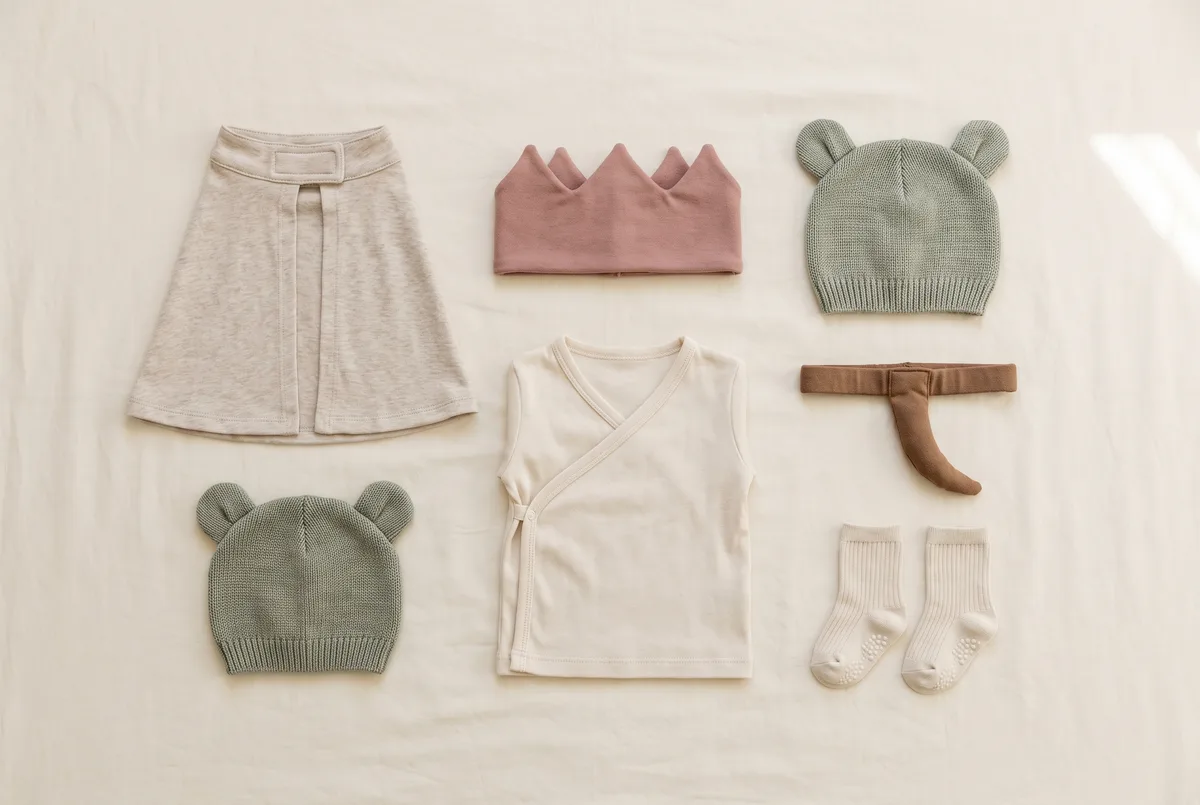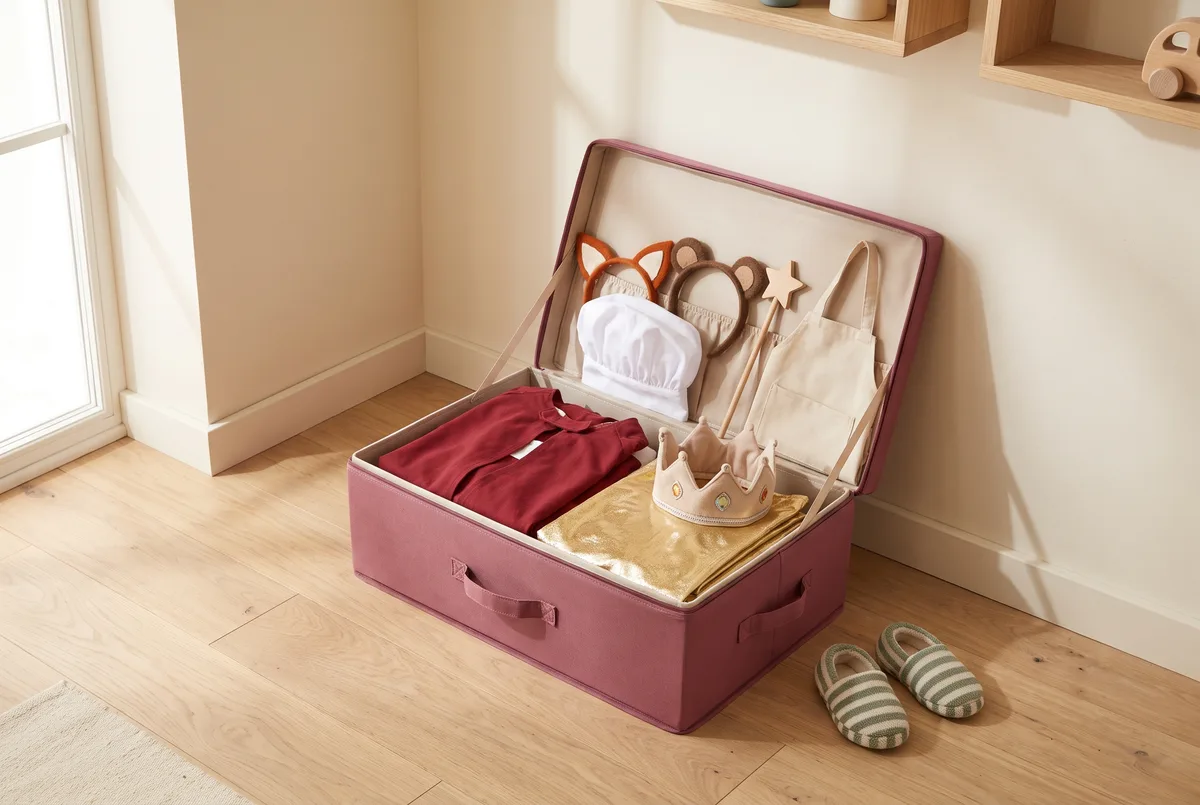
Run the movement test first
Before any of the item-by-item checks below, put the whole costume on the child and watch them use it. Almost every genuine problem shows up in the first two minutes of movement, and none of it shows up on a hanger.
Six things to watch. Can they see to the side without turning their head? Can they breathe through the mouth and nose with the face covering on? Can they walk and climb three stairs without gathering fabric in a hand? Can they sit on a hard chair? Can they manage the bathroom alone? And can they get a coat on over the top without the costume stopping working?
If any of those fail, fix that before worrying about anything else. A costume that passes all six is already safer than most of what is sold, and one that fails two or three is not going to be rescued by careful supervision on the night.
Vision and breathing
Full-face masks are the single most common reason a costume gets abandoned, and the reason is usually mechanical rather than dramatic: the eye holes are cut for an adult-proportioned face, so they sit high on a child and slide as the child moves.
The specific risk is peripheral vision. A child who can see straight ahead but not to the side steps into furniture, other children, and — on Halloween night — the road. Check by standing to one side of them and asking them to tell you when your hand appears.
Better options, in rough order of how well they hold up: face paint, which restricts nothing; half-masks that leave the mouth and nose clear; hoods and ears, which read instantly and never slide over the eyes; and hats, provided the brim does not cut the sightline. If your child is set on a full mask, treat it as a photograph item to be carried and put on briefly, not worn for the walk.
Hoods deserve a separate look. A hood that fits closely enough to stay up can also restrict hearing, which matters near traffic for exactly the same reasons vision does.
 All three of these do the same job as the mask and restrict nothing. If the full mask is non-negotiable, treat it as something carried and put on for photographs.
The neck is the highest-stakes area
This is the part of the checklist we would not compromise on.
The US Consumer Product Safety Commission treats neck and hood drawstrings in children's upper outerwear in sizes 2T–12 as a strangulation hazard, and its drawstring guidance sets out why. That guidance is written for outerwear, but the physics do not care what the garment is called, and dress-up capes are frequently sold with exactly the tie closure the rule exists to prevent.
The fix takes thirty seconds. Cut the ties off and replace them with a hook-and-loop tab, a snap, or any closure that releases under pressure. A cape should come away if it catches on a bannister, a climbing frame, a car door, or another child. If you are buying rather than modifying, look for the tab closure in the product photographs before you look at anything else.
While you are at the neck: no long necklaces, no medallions on cord, and no scarves that wrap more than once on a child under about five.
Small parts, magnets, and batteries
These are the three ingestion hazards, and they carry very different consequences, which is why they are worth separating rather than lumping into "small pieces."
| Hazard | Who is at risk | What actually happens | The check |
|---|---|---|---|
| Small parts | Mainly under-threes | Choking | Anything that passes through a cardboard tube comes off the costume |
| High-powered magnets | All ages, including older children | Two or more attract through the gut wall and cause serious injury | No loose or separable magnets on costume jewellery or props |
| Coin and button batteries | Mainly under-fives, but not only | Severe burns to the throat and esophagus within hours | Battery door must need a tool to open |
On small parts, the federal test cylinder used under 16 CFR 1501 is 1.25 inches across. An empty toilet paper tube is wider than that — roughly 1.7 inches — so it over-flags rather than under-flags, which is the right direction of error for a kitchen-table check. Loose gems, shank buttons, snaps, beads, and shedding sequin trim are the usual offenders.
On magnets, the concern is specifically the strong rare-earth type used in some clasps and detachable props, not a fridge magnet. Multiple magnets swallowed separately can attract to each other through tissue, which is a surgical emergency rather than a wait-and-see. CPSC issued a rule covering loose and separable magnets in consumer products for this reason. If a costume clasp detaches and is strongly magnetic, take it off.
On batteries, light-up wands, tiaras, and shoes are the common source. Reese's Law set federal requirements for child-resistant battery compartments and warnings on products using coin cells; CPSC button battery guidance covers what it requires. Our own line is simple: if the battery door opens without a screwdriver, the item does not stay in the house. Check the screw each time the piece comes back out for a new season, because they loosen.
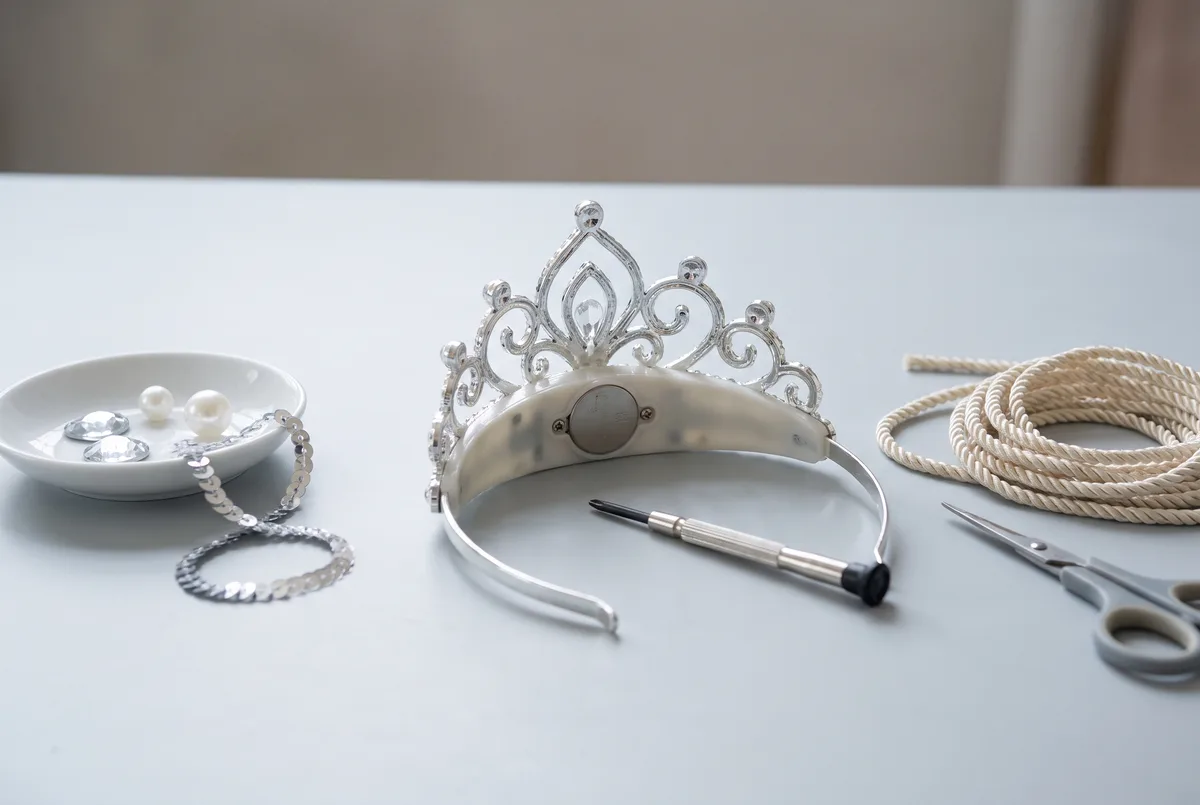 The screw is the thing to look for. A battery compartment that opens with a fingernail is a different product from one that needs a tool, whatever the packaging says.
Feet and footing
Costume shoes are the most reliably disappointing part of any outfit. Injection-moulded plastic soles have very little grip on wood, laminate, wet leaves, or a school hall floor, and dress-up is played at speed.
Use the child's own shoes. Nearly every costume survives the substitution, and for anything involving walking outdoors — Halloween especially — familiar, broken-in shoes with grip are worth more than a matching pair the child has never worn.
The other footing issue is hem length. Anything that reaches the floor gets stepped on, and the moment that matters is stairs and kerbs. Cape and skirt hems should sit above the back of the knee, or at absolute most mid-calf. If a costume is too long and cannot be shortened, a wide sash to blouse the fabric up at the waist buys you several inches in about a minute.
Face paint and what the label actually says
Face paint is regulated as a cosmetic in the US, which means the colour additives in it must be approved by the FDA for cosmetic use — and, separately, approved for use near the eyes, which not all of them are. Those are two different permissions, and the second is the one that gets missed.
Three practical rules follow. Use products sold and labelled as face paint or cosmetics, never craft paint, poster paint, or marker pens — these are not formulated for skin and some contain pigments never assessed for it. Read whether the product says it is safe for the eye area before painting anywhere near eyes. And patch test on the inner arm a day ahead, because a reaction discovered at the party is a ruined evening and a reaction discovered the day before is simply a different plan.
Remove it before bed rather than after. Paint transfers to bedding, and rubbing at eyes overnight is how a mild irritation becomes a sore one.
Glitter is the other item worth naming. Craft glitter in the eye is a genuine corneal-scratch risk; if you want sparkle on a face, use a cosmetic-grade product designed for it.
Flammability, the check almost nobody runs
This one rarely appears in costume guides and it should. Costume fabric is often lightweight polyester or nylon with a loose weave — exactly the combination that ignites readily and burns quickly.
The exposures are seasonal and specific: candles in jack-o'-lanterns on doorsteps and paths, tea lights on party tables, open fires, log burners, and patio heaters. A trailing cape or a tulle skirt passing a lit pumpkin at ankle height is the realistic scenario, not a dramatic one.
Look for a "flame resistant" label where one exists, keep long loose layers away from any open flame, and use battery tea lights and LED pumpkin candles for anything at child height. Flame resistant does not mean fireproof; it means the fabric resists ignition and self-extinguishes, which buys time rather than removing risk.
Dark, cold, and outdoors
Halloween night adds three problems at once: low light, excitement, and a costume chosen for daylight photographs.
Visibility. Dark costumes are close to invisible to a driver at dusk. Retroreflective tape on the back of the costume, the treat bag, and the shoes is the highest-value addition, because it returns light directly to a car's headlights. Glow sticks are cheerful and help children see each other, but they do not perform the same job for drivers.
Warmth. Decide before the night whether the costume goes over the coat or under it. A costume built around shoulder details or wings usually stops working the moment a jacket goes on, and at seven in the evening in October the jacket is not optional. Build the signal above the neck where a coat cannot cover it, and the problem disappears.
Carrying. Assume any prop will be put down within the hour. A sword, staff, basket, or wand that must be held occupies a hand the child needs for balance and for holding yours near a road.
Walk the route in the costume, in the dark, before the night if you can. Kerbs, driveways, and unlit paths look different when a hem is dragging and the child is excited.
After the event
The end of the evening is the right moment to sort, because it is the only moment you will handle every piece.
Take the batteries out of anything light-up before it goes into storage. Coin cells left in a drawer for a year corrode, and a loose battery in a toy box is the exact scenario the safety rules exist to prevent.
Wash what can be washed, and check the seams as you fold. Trim that has started shedding will be worse next season, not better. Anything with a failed closure either gets fixed now or leaves the house now, because it will not get fixed in October.
Keep the reusable, screened pieces and let the rest go. A costume collection that has been through this sort once a year stays a collection of things you have actually checked — which is the entire point of a checklist that runs before the event rather than during it.