At this age, wearing is the whole game
A three-year-old puts on a cape to be somebody. An eighteen-month-old puts on a cape because it feels good on their shoulders and because it is an interesting thing that can be put on.
That distinction decides everything else on this page. Buying for a toddler as though they are a small preschooler — full character outfits, accurate detail, matching accessories — misreads what they are actually doing. Symbolic play, where one object deliberately stands in for another, is only starting to appear somewhere around eighteen months to two years, and it is short and fragmentary at first. The elaborate stories arrive at three and four.
So the useful questions for this age are physical, not thematic. Does it go on easily? Does it feel nice? Can they get it off when they have had enough? A plain soft cape scores well on all three. A fastened, structured costume with a hood and a tail scores badly on all three, regardless of how good it looks.
Pull-on beats fastened, every time
If there is one buying rule for this age, it is this: the child should be able to get the piece on and off without an adult.
Toddlers are working hard on doing things themselves, and a costume that requires help converts dressing up from an independent activity into a request. That is the difference between a piece worn twenty times and a piece worn twice.
In practice that means favouring:
- Pull-on shapes — ponchos, tabards, wrap tunics, and capes that go over the head rather than fastening behind.
- Wide neck openings. This is the single most common failure point. A neck hole that has to be forced over a toddler's head produces exactly one wearing.
- Hook-and-loop tabs over buttons, snaps, ties, and anything at the back.
- Elastic that is wide and soft rather than narrow and firm — waistbands and headbands both.
And avoiding back zips, hook-and-eye closures, shoulder buttons, and anything that fastens where the child cannot see it.
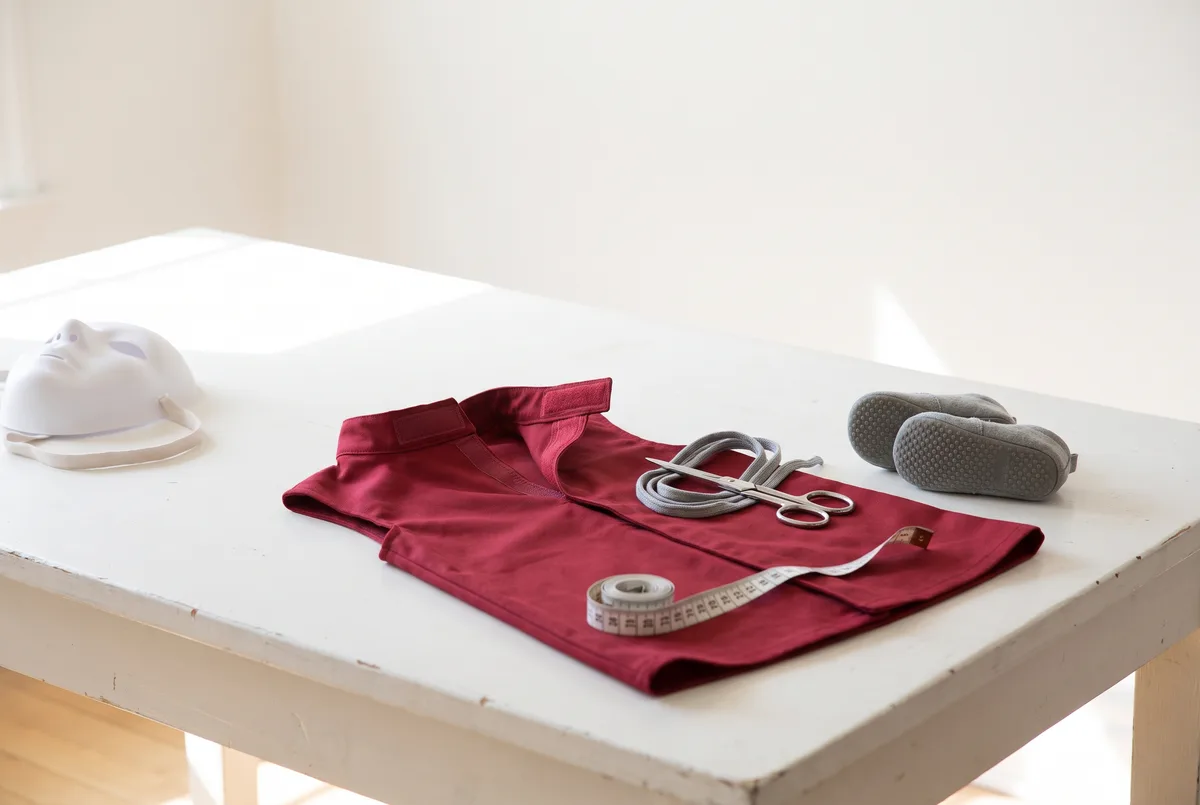
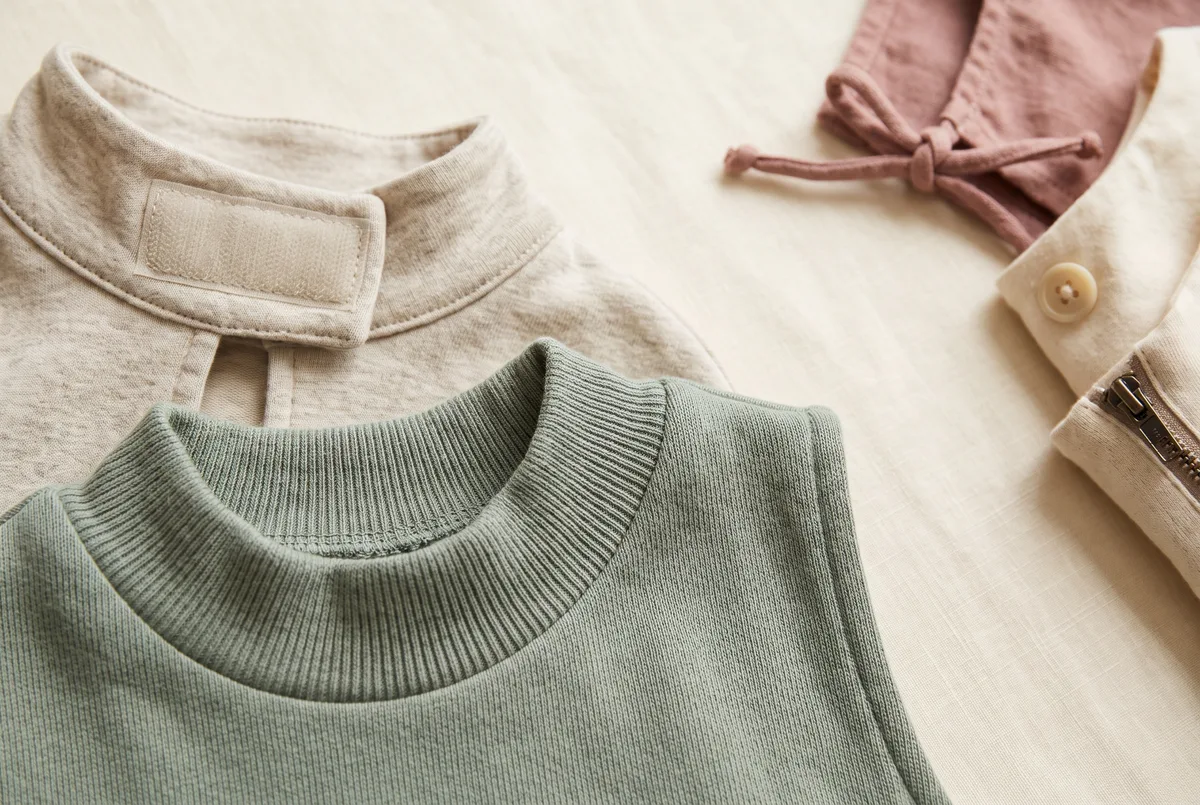 Left, a toddler can manage alone. Right, they need you — and the cord tie should not be on a child's costume at all.
Five to eight pieces, and what they should be
A toddler collection does not need to be large. Five to eight items is plenty, and a smaller set genuinely gets used more, because the choice is visible rather than buried.
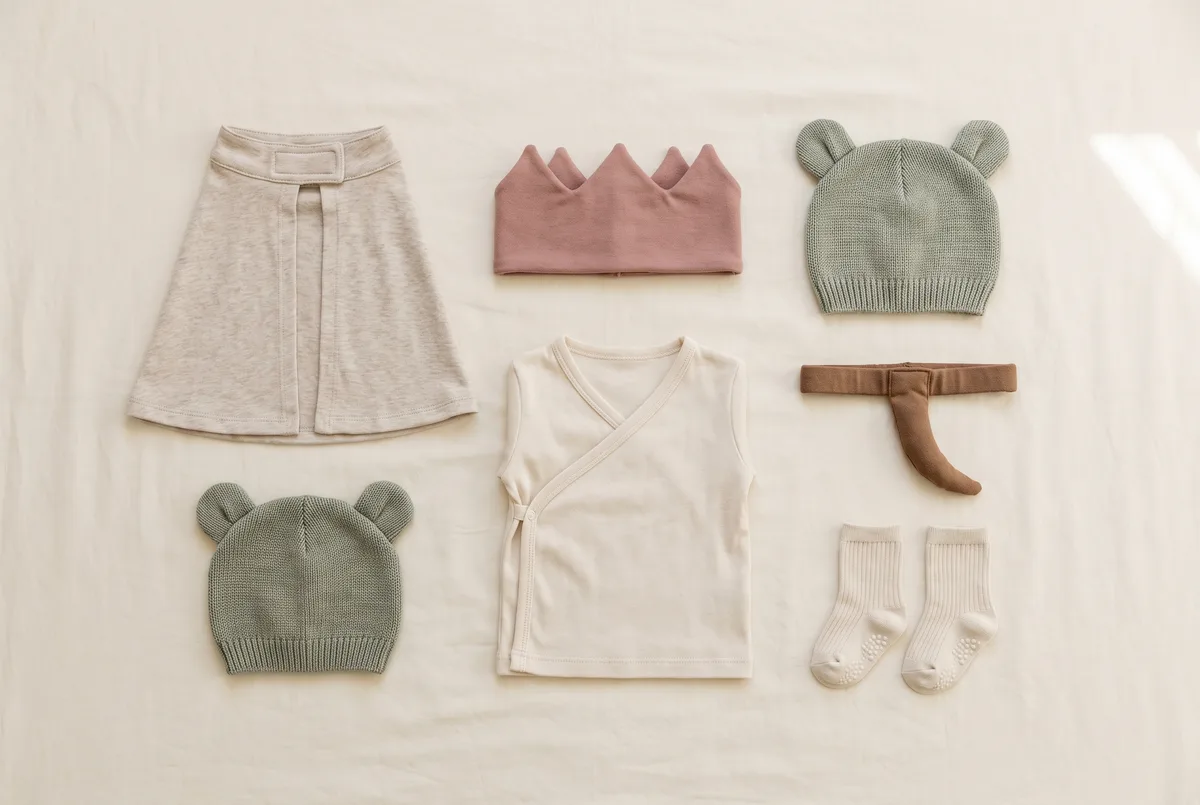
We would build it roughly like this. Two capes in different colours — the most-used category by a wide margin, and versatile enough to carry animal, royal, weather, and superhero-adjacent play. One or two soft head pieces: knit animal ears, a fabric crown with no rigid points, or a soft hat. One wrap or tabard in a plain colour, which becomes an apron, a doctor's coat, a shopkeeper, or a knight depending on the day. One or two role props that are large enough not to be a small part — a wooden spoon, a fabric bag, a chunky pretend phone. And grip socks or their own shoes, never costume shoes.
That is it. Resist the boxed sets at this age; they are almost always built around fastenings and small parts, which are the two things that do not work here.
What to leave out until three
Some of these are safety, some are simply futility. Both are worth knowing.
Anything with small parts. Under three is the age band the federal small-parts rule is written for. Gems, beads, buttons, snaps, and shedding sequin trim all come off costumes and go in mouths. The cardboard-tube check — if a piece drops through an empty toilet roll tube, it is out — over-flags slightly, which is the right direction here.
Cords and ties at the neck. Non-negotiable. CPSC's guidance on neck and hood drawstrings covers children's upper outerwear from size 2T upward as a strangulation hazard, and a cape that ties at the throat presents the same geometry. Cut the ties off and replace with a tab.
Coin batteries. Light-up wands and tiaras are the usual source. If the battery door opens without a screwdriver, it does not belong in a toddler's reach.
Masks. Partly safety — vision and breathing — but mostly that toddlers take them off within about a minute. Face paint, ears, and hoods do the same job and stay on.
Long hems. A toddler who is still consolidating walking does not need fabric under their feet. Capes should sit above the back of the knee.
Rigid headbands with teeth. These are the most-abandoned accessory in dress-up. The comb digs in, and a toddler has no reason to tolerate that for a look they are not yet invested in.
There is a fuller version of these screens, with the sources, in our kids costume safety checklist.
Sizing: go up, not across
Toddler costume sizing is unreliable across brands, and the failure mode is consistently the same — sized for a slim child with nothing underneath.
Buy a size up as a default. A toddler dress-up piece is worn over ordinary clothes, frequently including a jumper, and the extra room costs nothing in appearance while buying another season of use. Length is the exception: a piece that is too long underfoot is a trip risk, so size up in width and check the hem separately.
Watch armholes in particular. A cape or tabard cut with tight armholes restricts exactly the shoulder movement toddlers use for climbing and reaching, and it will be rejected quickly.
Building themes without buying costumes
Toddlers read colour and one strong shape. That is the whole vocabulary you need.
A brown or tan outfit plus knit ears is a bear, a dog, a fox, or whatever they say it is — and letting them decide is better than telling them. Grey plus ears is an elephant or a wolf. Yellow plus a beak-shaped hood is a duck. A plain cape in any colour becomes weather, a bird, a cloak, or a shop awning depending on the hour.
The single most useful habit is to describe rather than correct. If a child in a green cape announces they are a frog, they are a frog, even if you bought it as a dragon. That flexibility is exactly the thing that makes plain pieces worth more than character ones at this age.
Storage they can actually use
One low, open bin. No lid.
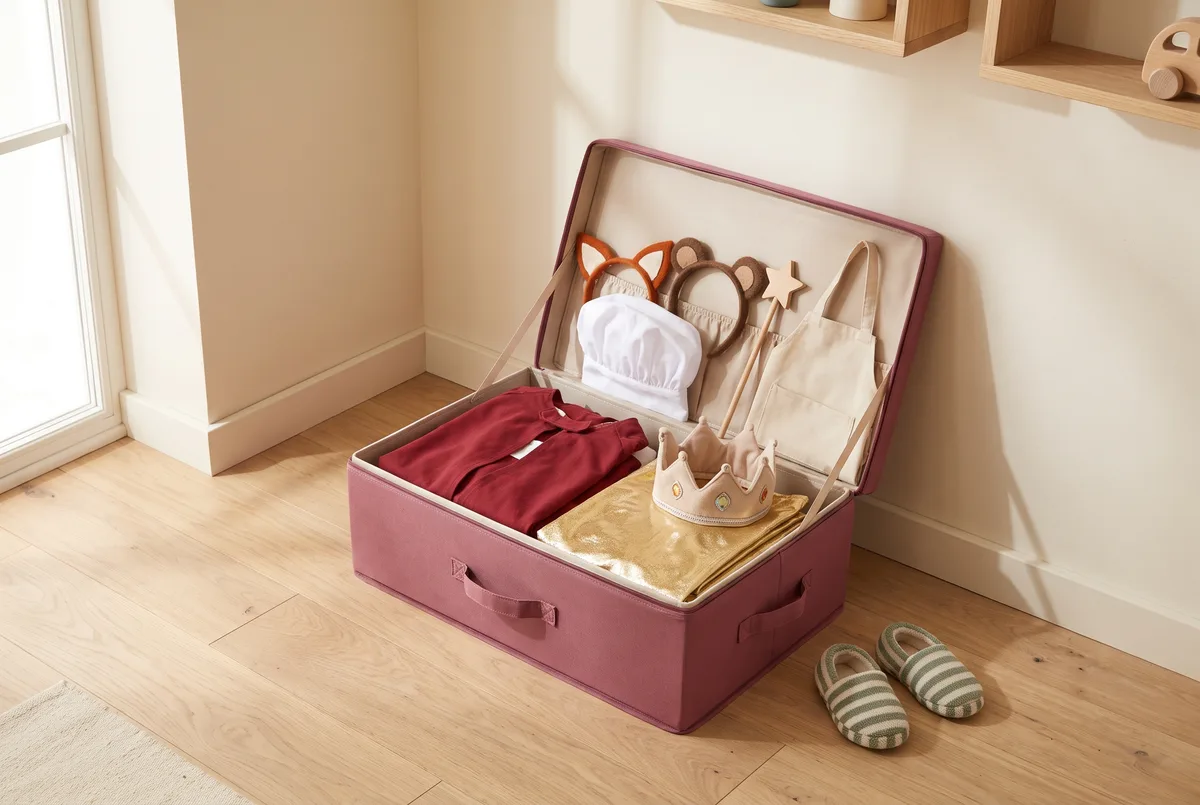
Lids are an obstacle at this age — they require two hands and some grip strength, and they hide the contents, which matters because a toddler chooses from what they can see rather than from what they remember owning. An open basket at floor level, positioned where they already play, gets used many times more than a beautiful lidded box in another room.
Keep it to the five to eight pieces. Cleanup at this age is a joint activity rather than a solo one, so the realistic target is that the child can help put things back, not that they will do it alone.
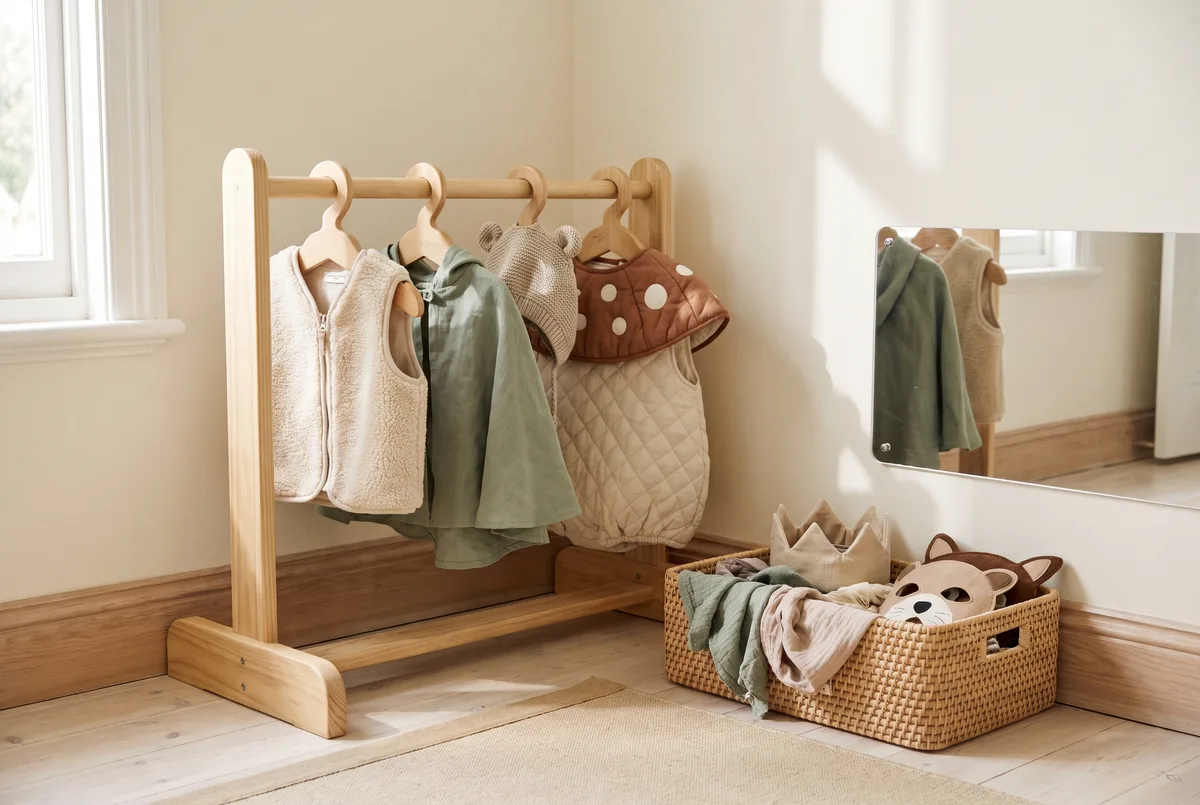 Low, wide-based, and open. The mirror at their eye level does more for engagement than any additional costume — seeing it on is a large part of the appeal.
Washability is a real specification
Toddler dress-up gets worn during meals, during painting, and outdoors. Anything that cannot go through a machine will either be worn cautiously or not at all, and cautious is not a useful mode for this age.
Check before buying: machine washable, and colourfast. Glued-on decoration is the usual failure — adhesive-set gems and appliqués release in warm water, which turns a decorative piece into a small-parts problem in one wash. Stitched decoration survives; glued decoration does not.
Cotton and cotton-blend jersey wash and wear better than costume satin and tulle, and they are also more comfortable against skin, which is the other half of the reason they get worn more.
When to change the collection
Two triggers, and neither of them is the calendar.
When they start narrating. Once a child begins saying what they are and what is happening — "I'm the doctor, you're sick" — they have moved into story-driven play, usually somewhere around three. That is the point to add role props, a second cape so two children can play, and pieces with more specific identity. Before that, adding detail is spending money on something they are not yet using.
When a piece is being ignored. Take it out for a month and see whether it is asked for. If it comes back into use, it was novelty fatigue. If nobody notices it is gone across two of those cycles, it has finished being useful and can leave.
The collection should stay small the whole way through. A toddler dress-up bin that has grown to twenty items has usually stopped being a set of choices and become a pile to be tipped out — and tipping it out is a different game from dressing up, however entertaining it is to watch.