Skip the wire
Almost every fairy wing tutorial online starts with wire and tights. We would start somewhere else, for three reasons that have nothing to do with difficulty.
Wire ends work loose. However carefully they are taped or bound, a bent wire frame eventually presents a sharp end, and it does so from inside the fabric where you cannot see it. Wire frames also hold their shape until they suddenly do not — once kinked, they stay kinked, and a bent wing is close to unrescuable.
Lightweight card, poster board, felt, or craft foam avoid all of that. They cut with ordinary scissors, they take decoration well, they crease rather than spike when they fail, and a child can wear them for an afternoon without an adult worrying about what is happening inside the seam.
The trade-off is honest: card wings last one season rather than several. For a party craft or a costume, that is the right trade.
Size them to clear a doorway
This is the measurement that decides whether the wings get worn or carried, and it is almost never mentioned.
Span: shoulder width plus about three inches on each side. Wider looks more dramatic laid flat on a table and is worse in every other respect — it catches on door frames, chair backs, and other children, which means the wings come off within the first fifteen minutes.
Height: no taller than shoulder to mid-back. Wings that rise above the head look striking in a photograph and hit every doorway.
Weight: as light as you can manage. Anything that pulls at the shoulders will be removed, regardless of how good it looks.
If you want drama, put it in the decoration rather than the dimensions. A modest wing in metallic paper reads far better in a room than an oversized plain one, and it survives the afternoon.
Shape: fold the paper
You do not need a butterfly outline. A rounded double-wing, a leaf pair, a teardrop pair, or a simple heart-lobe shape all read as wings once decorated.
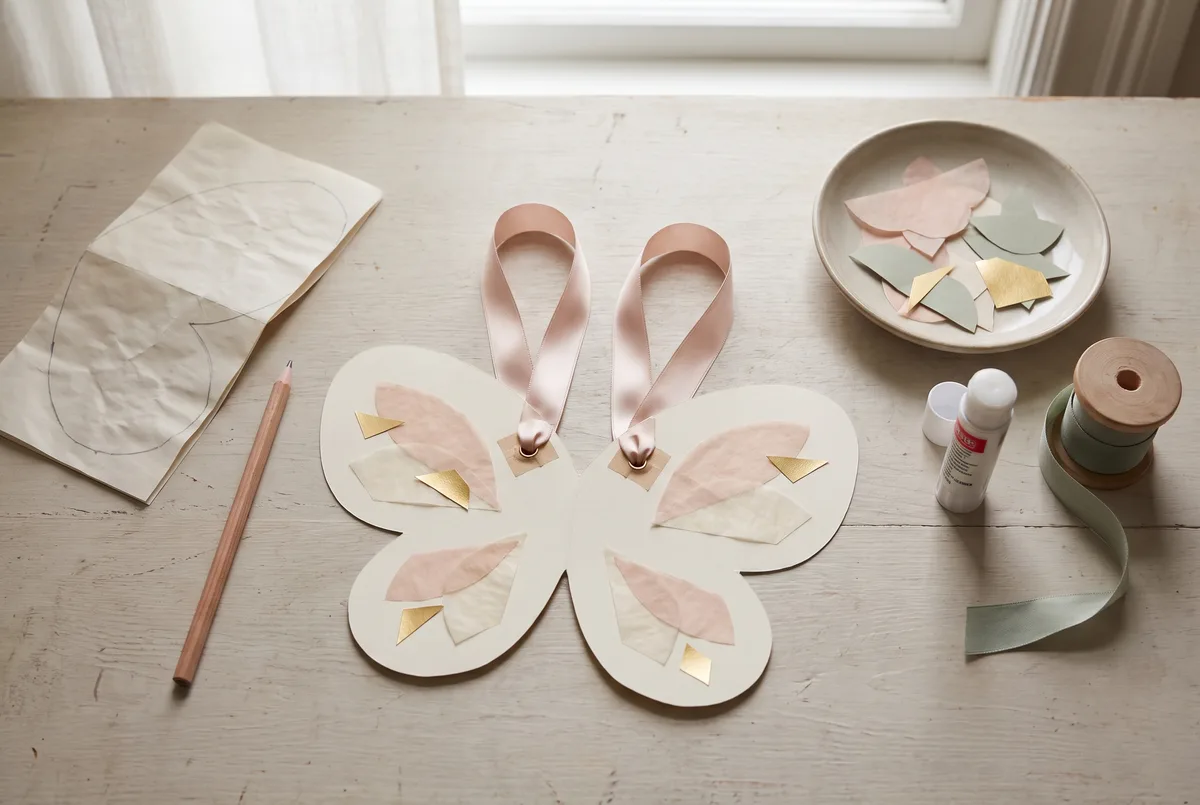
Fold a sheet of paper in half, draw one side against the fold, cut, and open it out. Symmetry comes free and the shape is yours. Transfer that to card, foam, or felt and cut the real thing.
Round every corner. Points are the part that catches, scratches, and bends first. A slightly softened silhouette is more wearable and, oddly, tends to look more finished.
If you are making several — for a party or siblings — cut one template from stiff card and trace round it. Cutting each freehand produces four visibly different pairs and a lot of unnecessary work.
Straps, by age
The strap decides whether the wings stay on, and the right answer changes with age.
| Age | Best option | Why | Avoid |
|---|---|---|---|
| Under 3 | Hand loops | Held like a cape, no shoulder pressure, on and off instantly | Anything over the head or round the neck |
| 3 – 5 | Soft ribbon shoulder loops | Adjustable, forgiving, easy to shrug out of | Narrow elastic, which digs in |
| 5+ | Wide soft elastic | Stays put during active play | Tight bands, anything crossing the throat |
Two rules apply at every age. Straps go over the shoulders like a backpack — never around the neck. And whatever you use, reinforce the holes: a patch of tape or a square of felt on both sides before you punch through, or the hole tears out on the first enthusiastic spin.
Fit over the actual outfit, not over a T-shirt. A jumper changes the strap length by a surprising amount, and wings fitted in July do not fit in October.
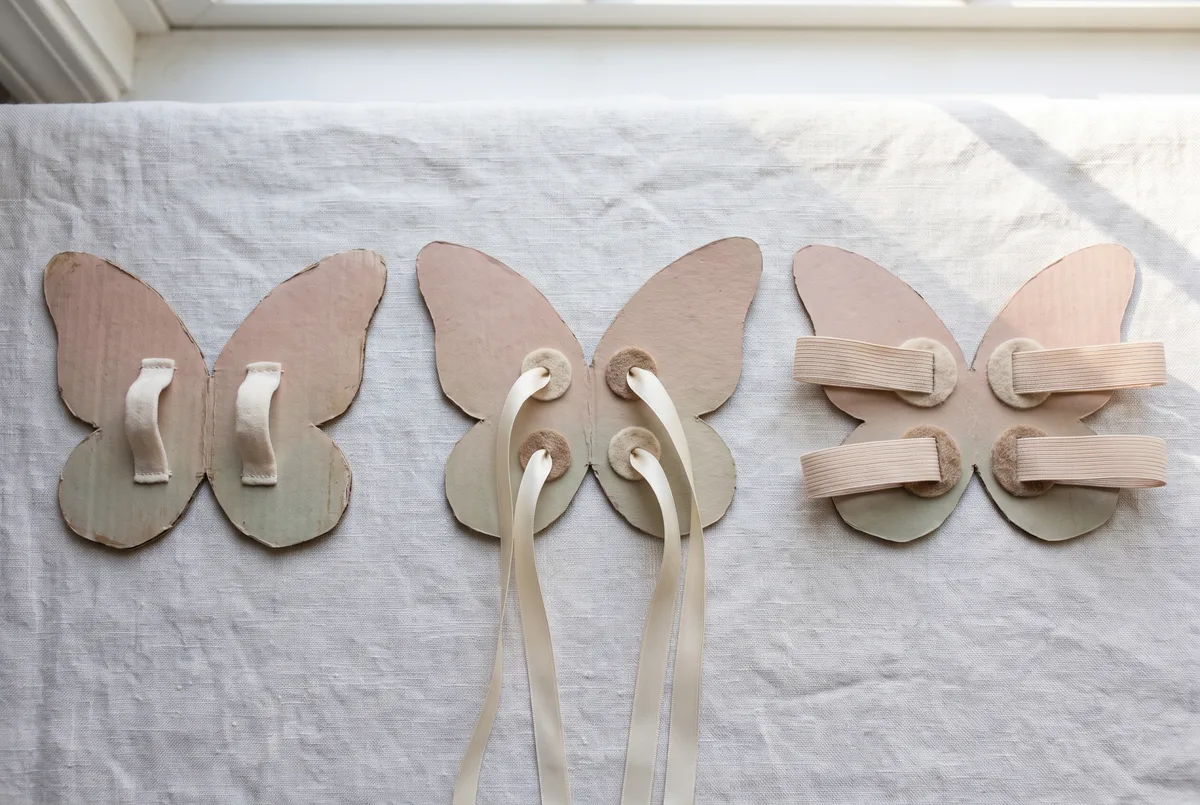 Hand loops, ribbon loops, wide elastic — left to right, roughly youngest to oldest. Note the felt patches around every hole; that reinforcement is what stops the strap tearing out.
Decoration that does not create a mess
Set out a small menu rather than everything you own. Four or five options produce better results than fifteen, because a child faced with too much choice tends to layer everything on until the shape disappears.
Works well: stickers, pre-cut paper shapes, metallic and glitter card, washable markers, tissue paper, ribbon, paper doilies.
Works badly: loose glitter, tiny gems, sequins, and anything needing liquid glue in quantity. Loose glitter in particular is worth refusing outright — it ends up in eyes and on floors, and glitter card gives the identical effect with none of it.
Glue sticks over liquid glue, every time. If you must use liquid glue, decant it into a dish with a cotton bud or small brush rather than handing over the bottle.
Running it as a party craft
The two things that go wrong at a party are cutting and drying. Both are avoidable.
Cut everything in advance — the wing bases and the decorative shapes. Scissors at a party create a queue and put one adult on cutting duty for twenty minutes while everyone waits. If you want children to cut something, give them a small optional extra task rather than putting cutting on the critical path.
Attach the straps afterwards. Let them decorate flat wings, then fit the ribbon while the glue sets. This also lets you fit each pair to the actual child rather than guessing.
Budget 30 to 45 minutes with the bases pre-cut, and run it early in the party while everyone is still settled. Once a group of preschoolers has been running around, getting them back into chairs for a craft is genuinely hard — there is more on party sequencing in our fairy party guide.
Make one sample pair first. It tells you whether the card is too floppy, the straps are fiddly, or the decoration takes longer to dry than you have.
Variations worth knowing
The same base method covers a lot more than fairies, which matters for a mixed group.
Garden or woodland: leaf shapes in green and brown, veins drawn in marker. Night sky: navy card with silver stars and a moon. Rainbow: strips of coloured paper radiating from the centre. Dragonfly: long narrow double pairs in translucent tissue. Bat, bird, or beetle: the same silhouette in different colours.
Offering "wings" rather than "fairy wings" lets a child who has no interest in fairies join in without negotiating, and it costs nothing to phrase it that way.
For a sturdier finish, cover card wings with felt or fabric scraps, or seal paper decoration under clear contact film — worth doing if the wings need to survive a whole party rather than a single afternoon.
Storing them flat
Wings are killed by being stacked on.
Store them flat or upright: hung on a peg by the ribbon loops, slid behind a shelf or a chest of drawers, or standing on their edge beside the dress-up trunk. What does not work is the bottom of a bin, where the first heavy thing placed on top creases them permanently.
If a wing does crease, a strip of tape on the back across the fold restores most of the stiffness and is invisible from the front.
And when they are finished — and card wings do finish — keep the ribbon straps. They are the fiddly part, and the next pair takes half as long when the straps are already cut, sized, and reinforced.