Two hours, four moving parts
Almost every difficult children's party we have seen went wrong in the same two ways: it ran too long, and it had too many activities lined up.
For three- to six-year-olds, two hours is the honest ceiling. Ninety minutes is often better. Planning a shorter party is not cutting corners — it is the single change most likely to make the day go well.
The tipping point is easier to spot than to predict, and it is worth knowing the signal. It is not noise, and it is not a child crying. It is when the group stops playing together and fragments — two children drifting to a corner, one going to find a parent, one starting to take the costume off. That scattering usually arrives about fifteen minutes before the first real upset, which means it is your cue to move to food, or to cake, or to the quiet end of the plan. If you push through it and start another structured activity, the upset arrives on schedule.
Two hours is the ceiling precisely because the fragmenting tends to start somewhere in the second hour. A party that ends shortly after it is a party everyone remembers well.
Inside those two hours you need exactly four things: an accessory for each guest, one seated craft, one activity that lets them move, and a clear way to get the right things home with the right child. Everything else in this guide is detail on those four.
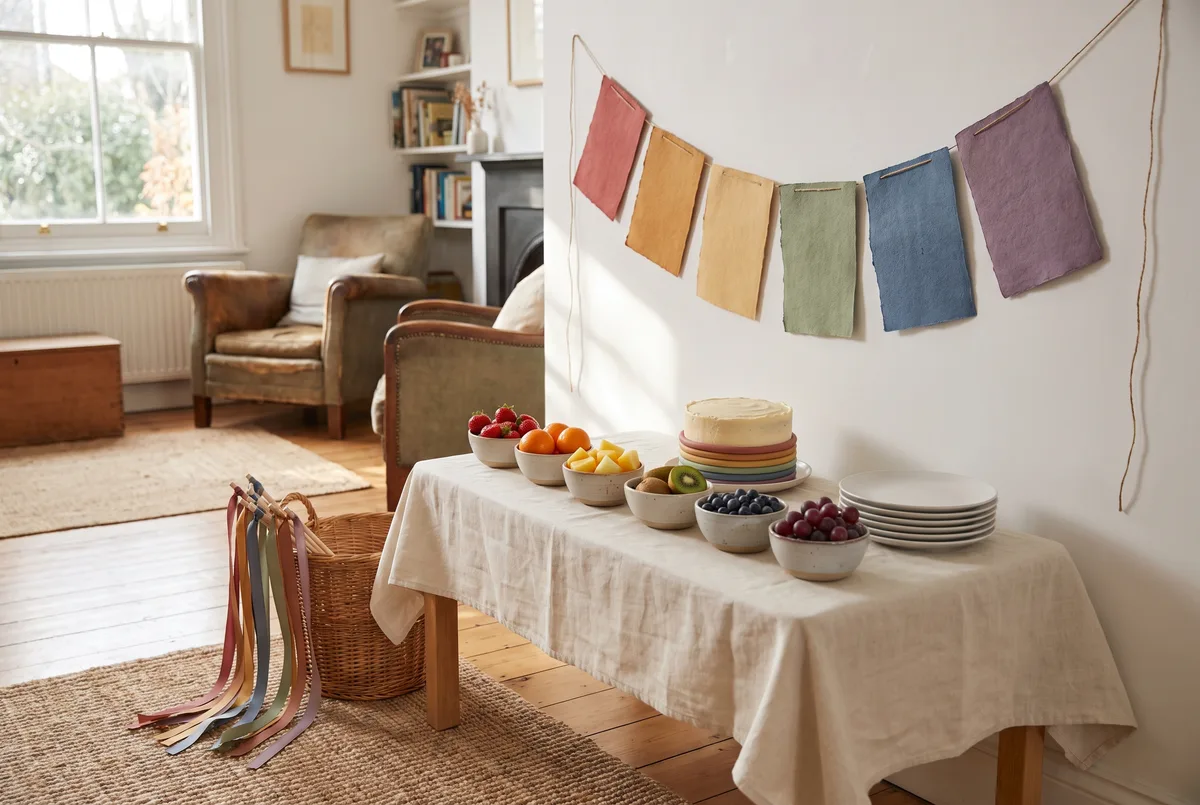
A palette does the decorating
A fairy party does not have to be pink from wall to wall, and the softer version is easier to pull off. Cream, lilac, mint, sage, pale blue, warm gold, and one deeper berry note all sit together comfortably.
Choose two or three and repeat them. Mint napkins, gold star stickers, and berry ribbon carry an entire theme without a single matching decoration being bought. Repetition is what makes a party look planned; quantity is what makes it look expensive, and only one of those is actually necessary.
Keep sparkle as an accent and choose the form carefully. Metallic paper, foil stars, ribbon, and glitter card give the effect. Loose glitter gives the effect and ends up in eyes, in the food, and in the carpet until roughly the following spring. This is the one material we would ban outright at a preschool party.
One accessory per guest
The most common overspend at a dress-up party is buying costumes. Guests do not need them, and children who arrive in their own outfit will not change into yours anyway.
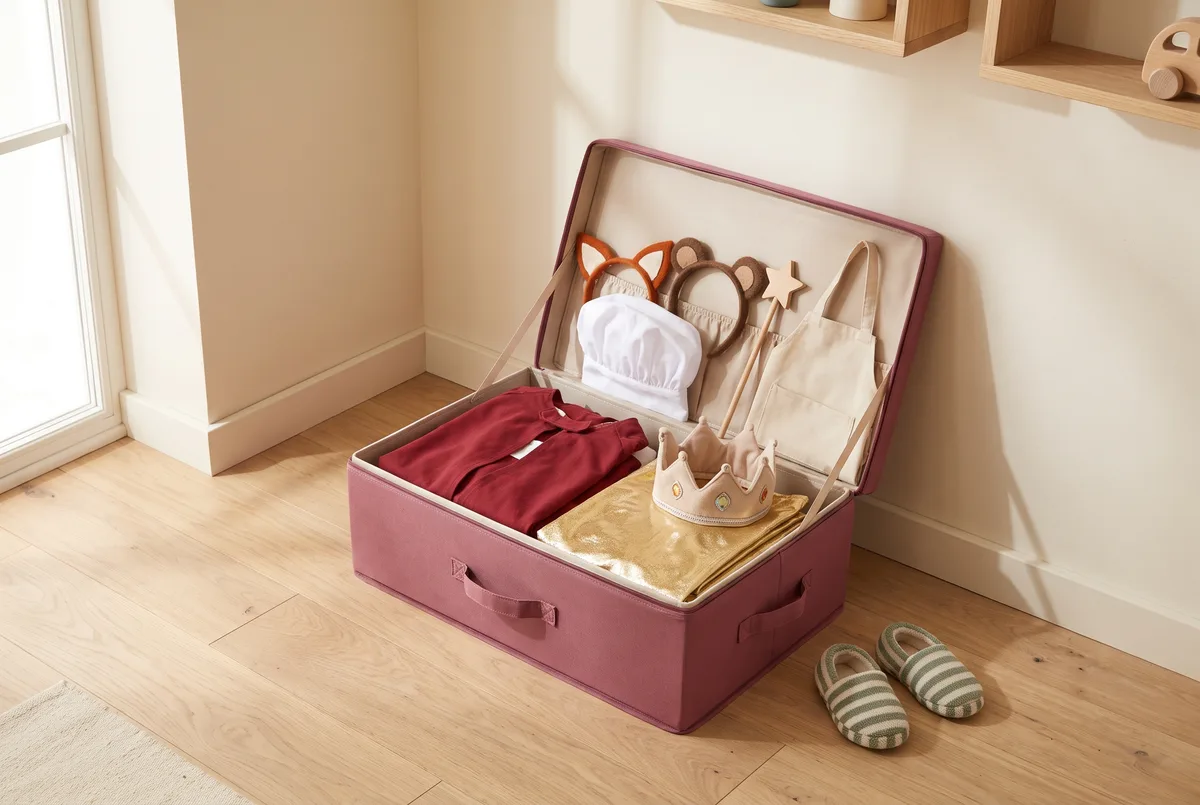
What works is one wearable thing handed to each child as they arrive: a set of wings, a flower crown, a ribbon wand, or a soft cape. It solves the awkward first ten minutes, it makes the group photograph work, and it goes home as the favour, which means you are not buying favours twice.
Set these out as a station rather than handing them over at the door. A low table, a tray for each type, a mirror at child height, and the children will sort themselves out. The mirror matters more than it sounds — for a lot of four-year-olds, seeing the wings on is the moment the party starts.
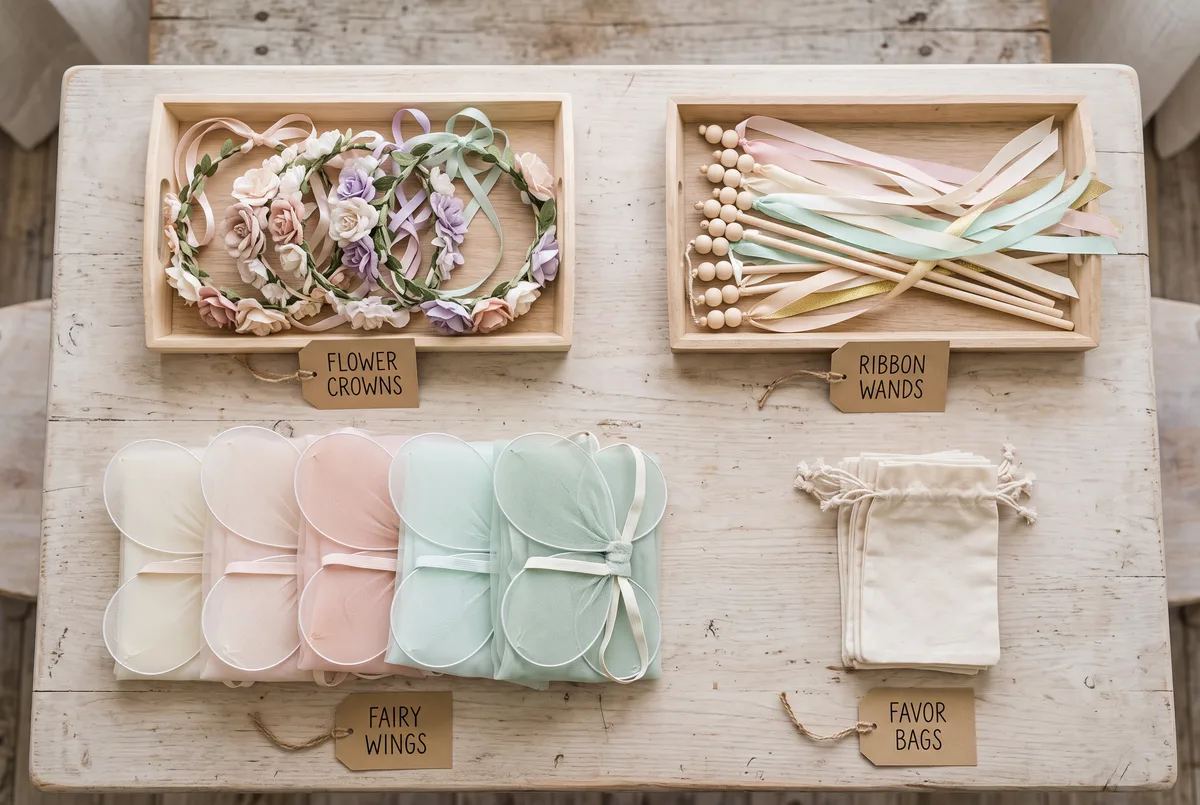 Zones with space between them. Children can serve themselves from a station laid out like this, which removes an adult from the busiest ten minutes of the party.
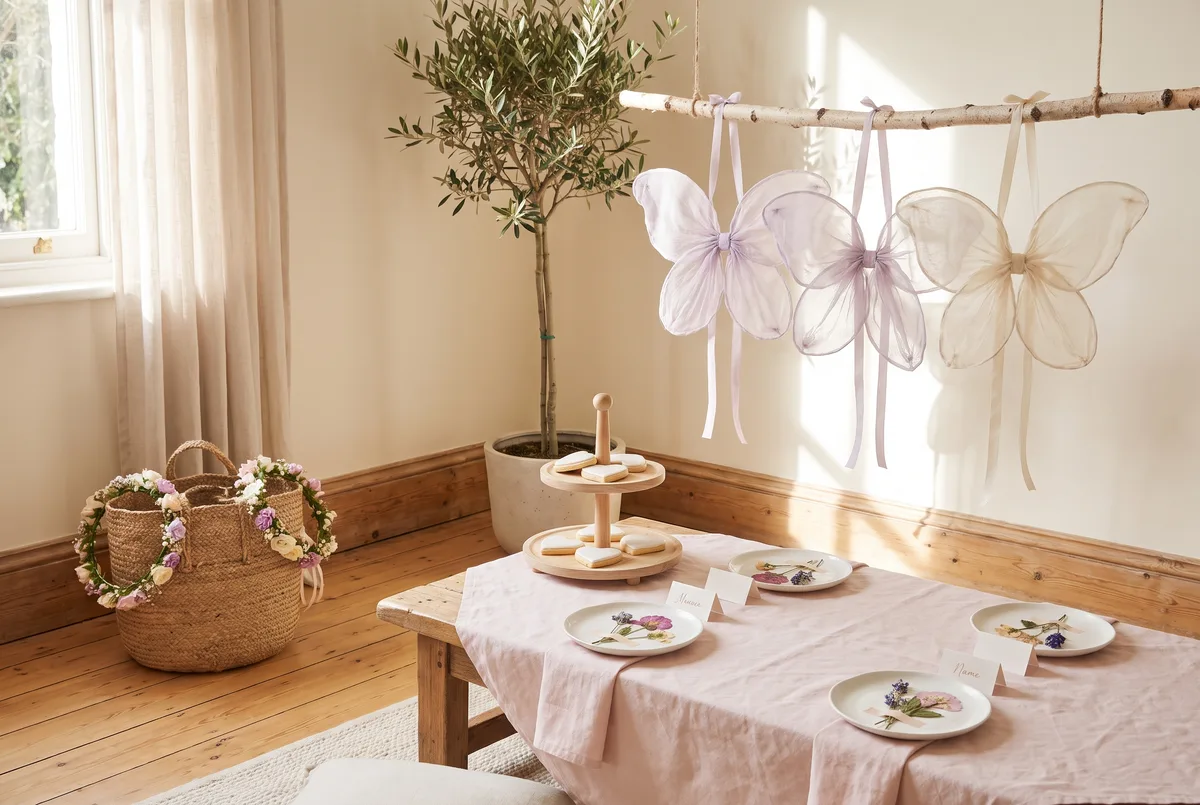
A note on wings specifically: check the strap before the party rather than during it. Elastic that digs in comes off within minutes, and a wing set with a rigid wire edge is worth leaving out entirely for under-fives. If you are making them, we cover the construction in DIY fairy wings.
Put the craft first
This is the ordering mistake nearly everyone makes. The seated craft goes before the running-around game, not after.
Once a group of preschoolers has been up and moving, getting them back into chairs to concentrate on gluing is genuinely difficult, and the craft ends up abandoned half-finished. Run it while they are still settling and slightly shy, and it does double duty — it occupies the arrivals gap and gets everyone talking.
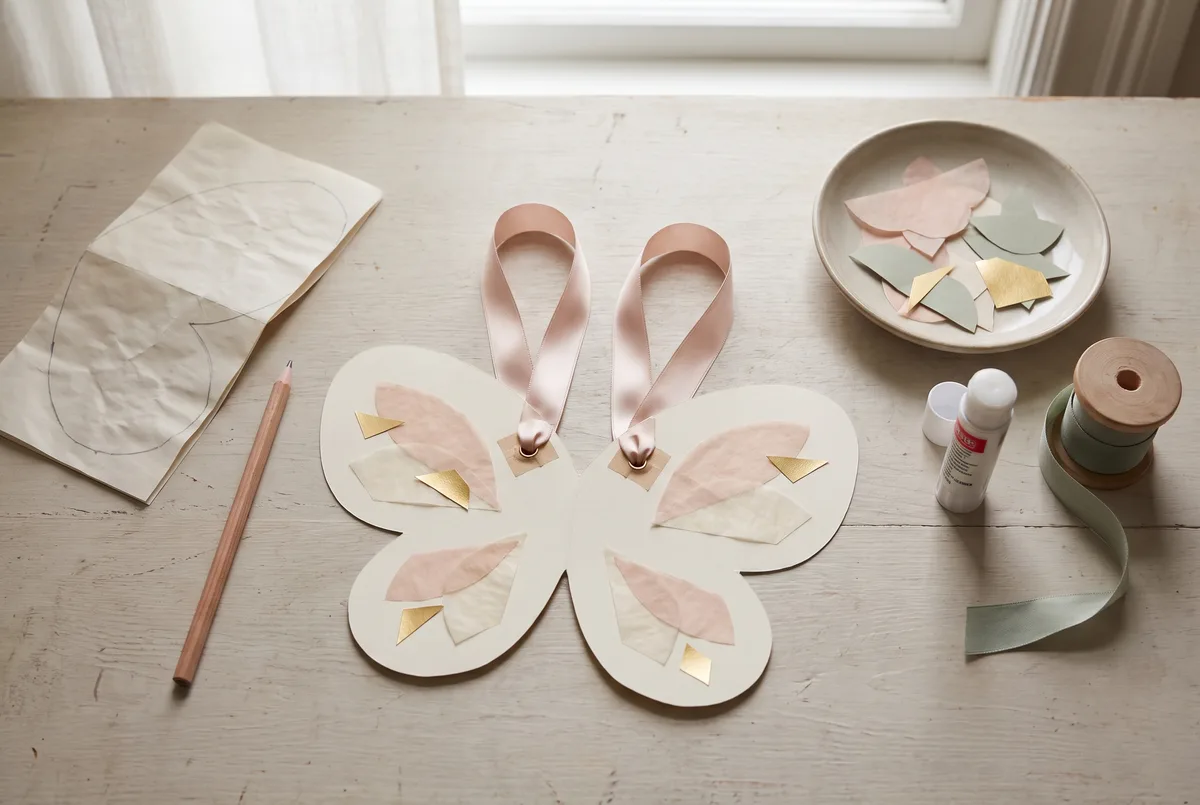
Pick one craft, not three, and make it finishable in about fifteen minutes. Decorating a pre-cut wand, adding stickers and paper shapes to a plain crown, or threading a ribbon bracelet all work. Pre-cut everything in advance; scissors at a party create a queue and a bottleneck of one adult doing all the cutting.
Glue sticks over liquid glue. Washable markers over paint. Nothing that needs to dry for longer than the party lasts, or you will be handing wet crafts to parents at pickup.
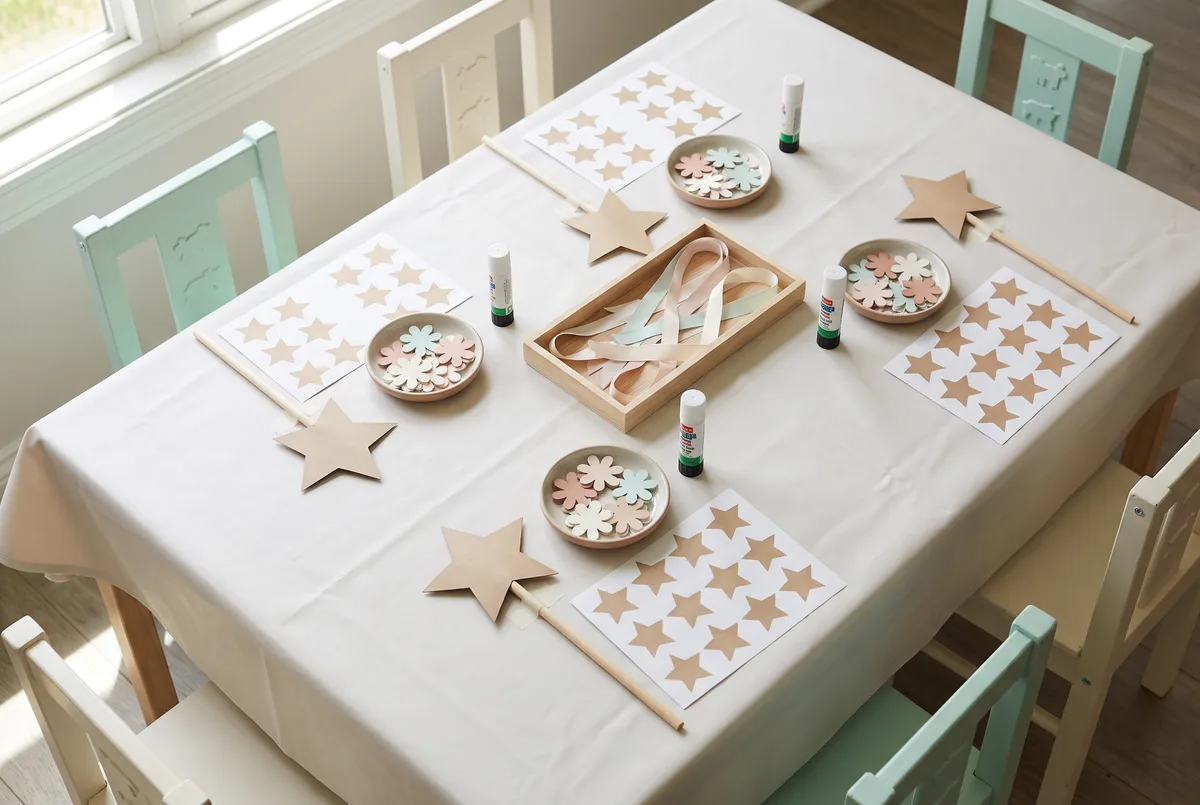 Portioned per child and entirely pre-cut. No scissors on the table means no queue, and no adult stuck cutting for twenty minutes while the craft stalls.
One movement activity, and a way to stop it
After the craft, they need to move. One game is enough.
Fairy-flavoured versions of the standards work fine — a hunt for paper flowers hidden around the room, freeze-dancing to music, or a gentle relay carrying something on a spoon. The theme matters far less than the movement.
What actually matters is having a defined ending. Games that run until the children get bored tend to end badly. Hide a fixed number of flowers and announce the number, so the hunt finishes when they are found. Play three rounds of freeze-dance and say so. A clear stopping point is what stops the party sliding into the overtired stretch.
Snacks apart from sparkle
Keep the craft table and the food table separate, physically. Glitter card, loose stickers, and small paper shapes migrating into a bowl of grapes is the single most predictable mess at this kind of party.
Serve simply. Plain iced biscuits, fruit, something savoury, and water or a single drink option is plenty. Elaborate themed food is the highest-effort, lowest-return item on the whole plan — four-year-olds eat very little at parties, and the biscuit that took two hours to decorate is eaten in nine seconds by a child who did not look at it first.
Ask about allergies when you invite, not on the day. And keep one plain option for the child who will not eat anything unfamiliar, because there is always one.
Getting the right things home
Handmade crafts vanish at pickup. The fix is a labelled spot: a shelf, a windowsill, or a row of paper bags with names on, set up before anyone arrives.
Write names as the craft is finished rather than at the end. Ten minutes after the fact, nobody can remember whose wand has the blue ribbon, including its maker.
Because the arrival accessory doubles as the favour, the take-home bag can stay almost empty — the wings, the crown, and whatever they made is already a generous send-off. If you want to add something, add one thing that lasts rather than a handful of small plastic items that will be gone by the weekend.
Making the theme wider
"Fairy" excludes some children, and it is easy to widen without losing anything.
Framing the invitation as garden, woodland, enchanted, or sparkle dress-up lets guests arrive as a fairy, an explorer, an animal, a wizard, a knight, or a bug, and every one of those fits the same decorations, the same craft, and the same games. Stock the accessory station accordingly: alongside the wings and crowns, put out a few animal ears, a couple of capes, and some plain ribbon wands.
The party looks identical. Rather more children arrive happy.
Where the money is worth spending
Costs at a dress-up party cluster in predictable places, and they are not the places most people worry about.
Worth spending on: the accessories. They are the theme, the ice-breaker, the photograph, and the favour, all in one line item. Buying a decent set of wings that survives being sat on is better value than the same money spread across decorations, and it is the thing children take home.
Worth spending on: enough of one thing. Running out of wands with two guests unserved is the only genuine disaster on this list. Buy for the number invited plus two, not the number expected to attend.
Not worth spending on: themed tableware. Plain plates in one of your two or three colours look better in photographs than printed character plates, and cost a fraction. The palette is doing the work.
Not worth spending on: elaborate food. Covered above, but it bears repeating as a budget line. The correlation between effort spent on party food for four-year-olds and food actually eaten is close to zero.
Not worth spending on: a backdrop. Wall decoration is the highest-cost, shortest-lived element of a small children's party. A branch with wings hanging from it, or nothing at all, photographs perfectly well.
If the budget is genuinely tight, the order to cut is: decorations first, then food elaboration, then favours, then guest numbers. Cut the accessories last — they are the party.
A running order that works
Two hours, in the order we would actually run it.
| Time | What happens | Why it sits here |
|---|---|---|
| 0:00 – 0:20 | Arrivals; accessory station open | Covers the ragged arrival window and gives shy guests a job |
| 0:20 – 0:40 | Seated craft | They are still settled and willing to concentrate |
| 0:40 – 1:05 | Movement game with a defined end | Energy is peaking; a stated stopping point prevents the slide |
| 1:05 – 1:30 | Food, then cake | Sitting down again resets the room |
| 1:30 – 1:50 | Free play in costume | Requires nothing from adults; absorbs any overrun |
| 1:50 – 2:00 | Named crafts handed out; goodbyes | Nothing left behind, nobody leaving mid-activity |
The free-play block near the end is the most useful twenty minutes in the plan and the one most often left out. It needs no supervision beyond the usual, it soaks up whatever ran long earlier, and it is frequently the part the children remember — they have the wings on, the pressure is off, and they are simply playing.
If everything overruns, cut the movement game to two rounds and protect the free play. If a guest arrives late and misses the craft, the station is still out and they can catch up. A plan with slack in it survives contact with actual four-year-olds; a tightly scheduled one does not.