The question is not which is best
There is no winner here, which is why the comparison is worth doing properly. Each of these three solves a different problem, and the reason people end up with the wrong one is that they choose from a photograph of somebody else's playroom rather than from an inventory of their own.
Two things decide it. What you own — a collection of capes and dresses behaves completely differently from a collection of fabric scraps, hats and props. And how your child tidies — some children sort willingly and some need the system to do the sorting for them.
Answer those two and the choice mostly makes itself.
Head to head
| Rack | Trunk | Low bins | |
|---|---|---|---|
| Visibility | Excellent — everything on show | Poor — bottom layer invisible | Good if open-topped |
| Reset speed | Slow: hangers are a fine-motor task | Fast, but becomes a jumble | Fastest — one category per bin |
| Best for | Capes, dresses, robes, coats | Mixed soft pieces, fabric, hats | Any collection, mixed ages |
| Floor space | Moderate, but wall-adjacent | Smallest | Largest |
| Youngest age it works | Around 4, when hangers click | Any age | Any age |
| Main failure mode | Overloaded, then ignored | Everything sinks to the bottom | Too many categories |
| Safety watch | Tipping | Heavy lids, pinched fingers | Climbing on the frame |
| Rough cost | Highest | Middle | Lowest |
The rack
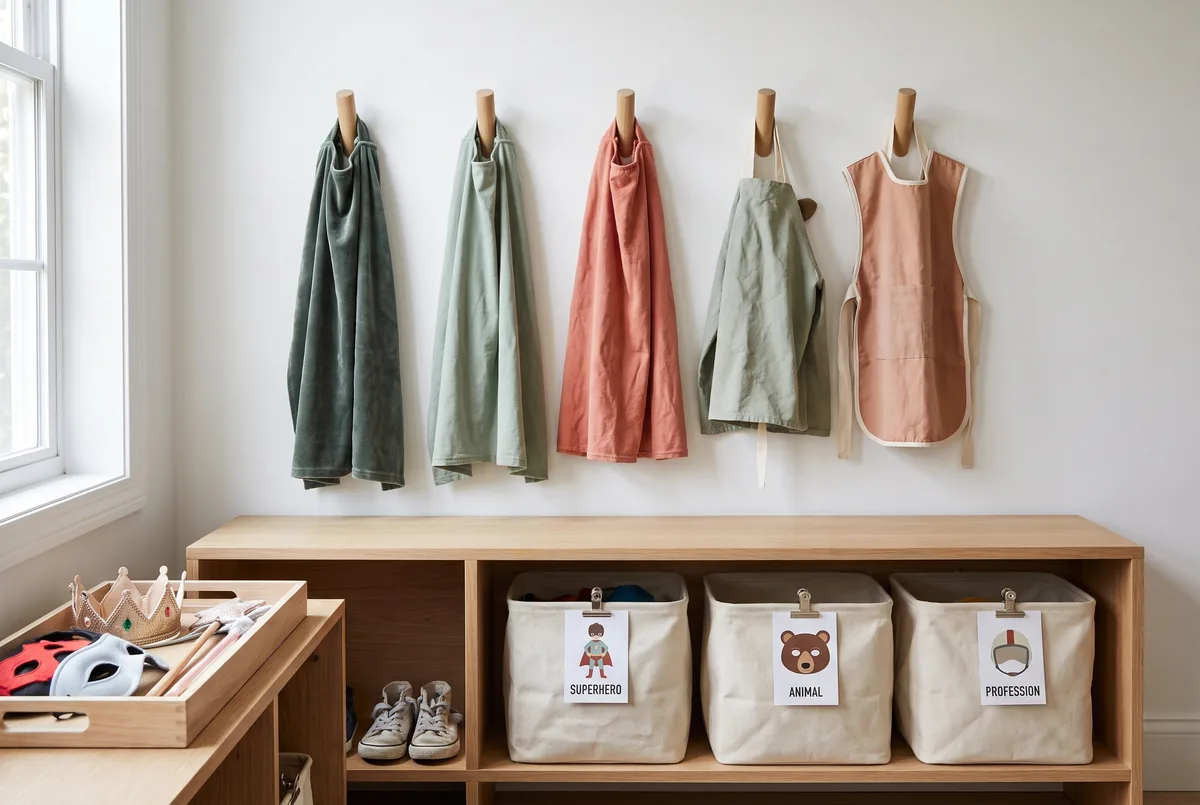
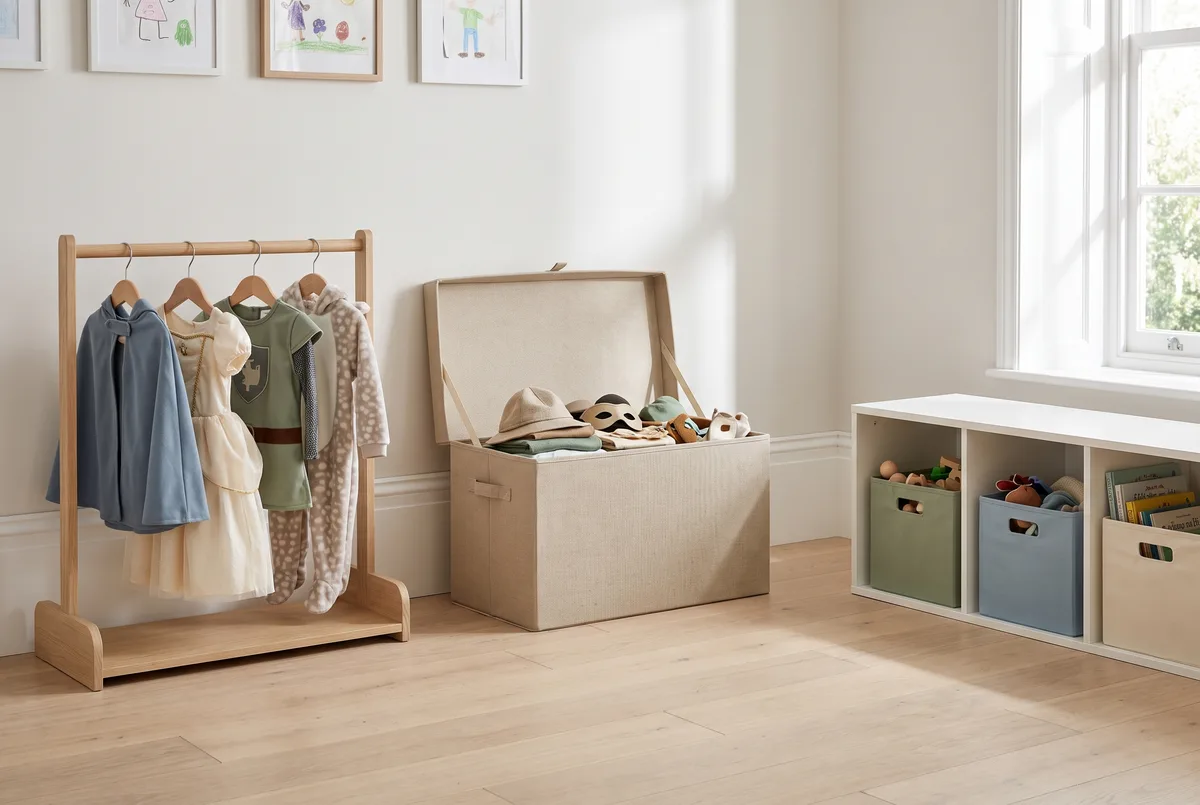
A rack earns its place when the collection is mostly hanging pieces — capes, dresses, robes, coats, tabards. Hanging keeps them visible, and visible things get worn. That is the entire argument, and it is a strong one.
The catch is fine motor skill. Getting a cape back onto a hanger and the hanger back onto a rail is genuinely difficult before about four, and a child who cannot do it will either leave the piece on the floor or hand it to you. If your child is younger, swap hangers for pegs or hooks — a peg is a drop-on action rather than a threading action, and it moves the rack from age four down to about two.
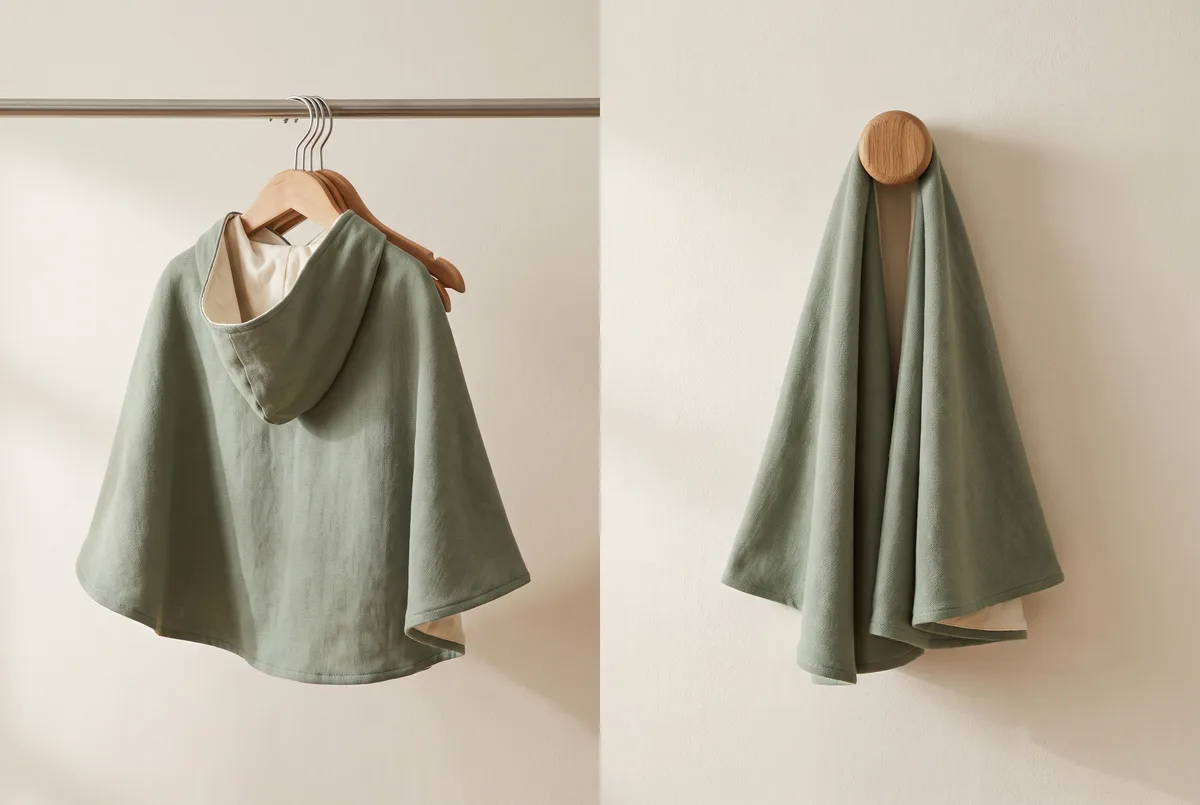 The difference is one action versus three. For a three-year-old that is the whole distinction between tidying up and asking for help.
Two buying checks matter more than anything in the product description. Base width against height: a rack is loaded from one side and pulled down on, so a low wide base is stable and a tall narrow one is not. And rail height — it should sit at roughly your child's shoulder, because anything higher means reaching up and pulling forward, which is how racks come over.
Keep it to five to eight pieces. An overloaded rail is hard to pull a single item from, and once it is hard the child stops using it and starts using the floor.
The trunk
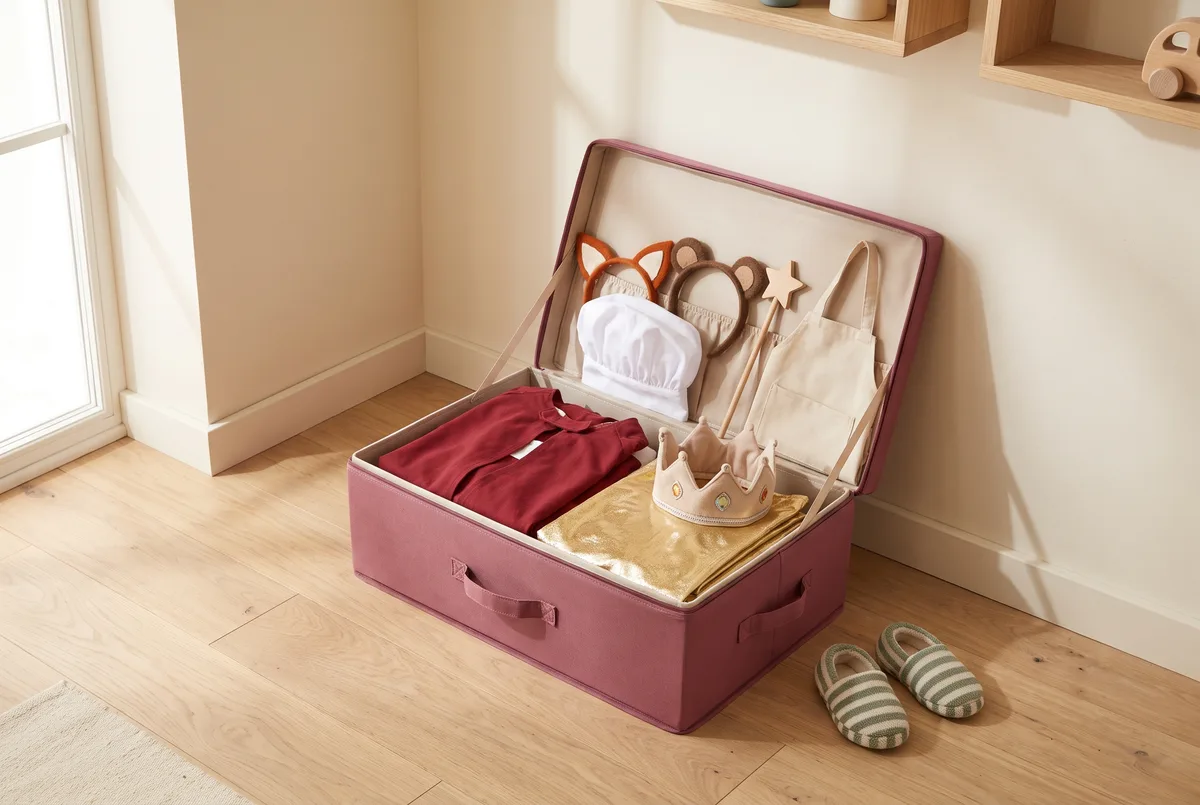
A trunk suits mixed collections: lengths of fabric, hats, soft props, scarves, a cape or two, things that do not hang well. It also wins on floor space and closes at the end of the day, which matters in a shared room or a living room that has to become an adult space in the evening.
Its weakness is structural and unavoidable: it is a deep container, so the bottom layer is invisible. Everything below the top few inches effectively stops existing, which is how a full trunk and a bored child happen simultaneously.
Two things fix most of it. Keep it shallow — a wide flat trunk is far better than a deep one, whatever the capacity numbers say. And keep the working set small enough that nothing needs to be excavated; we cover the piece count in how to build a dress-up trunk.
On safety, the lid is the thing to check. Soft or lightweight lids are fine. Heavy hinged wooden lids are the one configuration we would avoid outright — they pinch fingers, and a lid that drops is a lid children stop opening. If a trunk you already own has a heavy lid, taking it off entirely is a reasonable move.
Low bins
Bins are the least photogenic option and frequently the most effective, because they convert tidying from a judgement call into a sorting task.
"Everything in this bin is hats" is a rule a three-year-old can follow without help. That is a meaningfully different proposition from "put the dress-up things away," which requires the child to invent a system on the spot. If cleanup is your actual problem rather than storage, bins are the answer.
The failure mode is over-specification. Three or four categories work. Nine do not — at that point sorting becomes a chore in itself and everything goes in the nearest bin anyway. Broad and obvious beats precise: clothes, hats and heads, props, shoes is plenty.
Use open tops. Lids add a step, hide contents, and get left off. And pair words with pictures on the labels for pre-readers, which is the difference between a label that works and a label that is decoration.
The accessory tray, which is not optional
Whichever of the three you choose, small accessories need somewhere separate and shallow.
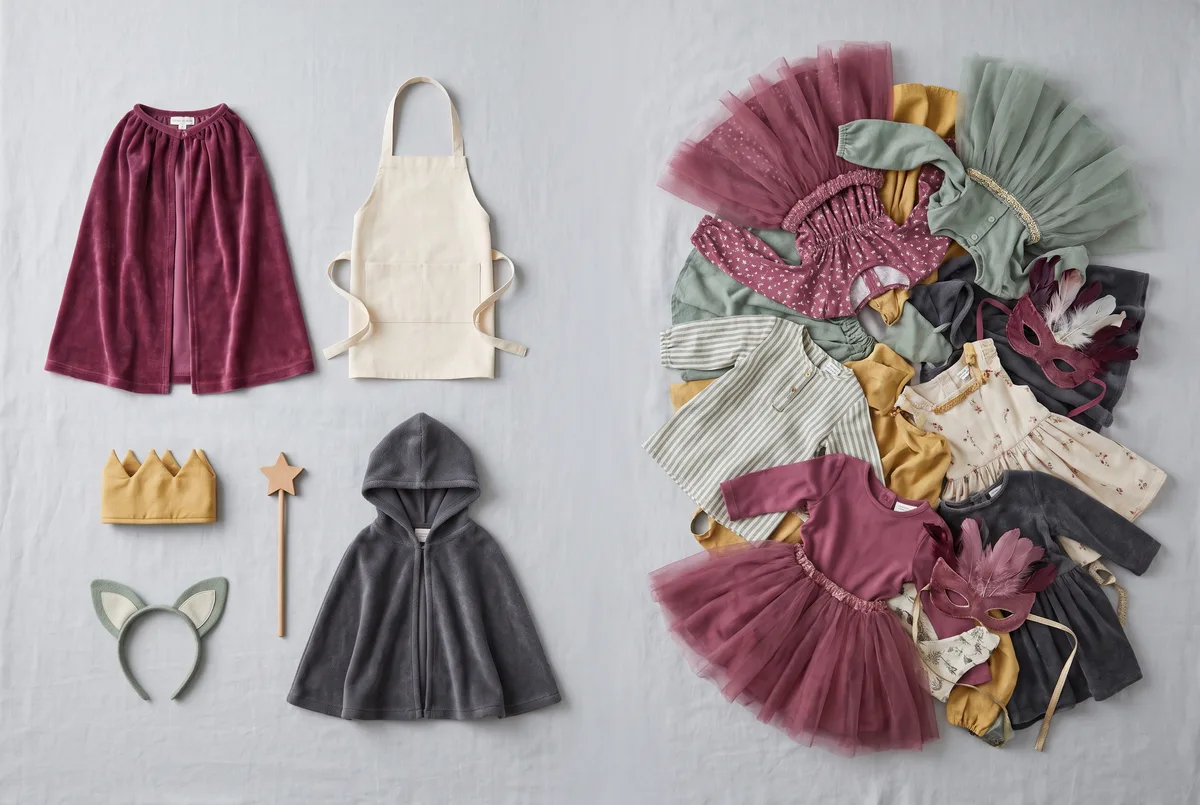
Wands, crowns, badges, glasses, clips and small scarves are the pieces that cause most of the visible mess, because they are small enough to fall through everything else and awkwardly shaped enough not to stack. In a trunk they sink. On a rail they cannot hang. In a deep bin they disappear under the clothes.
One shallow open tray at reaching height solves it, and it is the single highest-return five pounds or dollars in this entire guide.
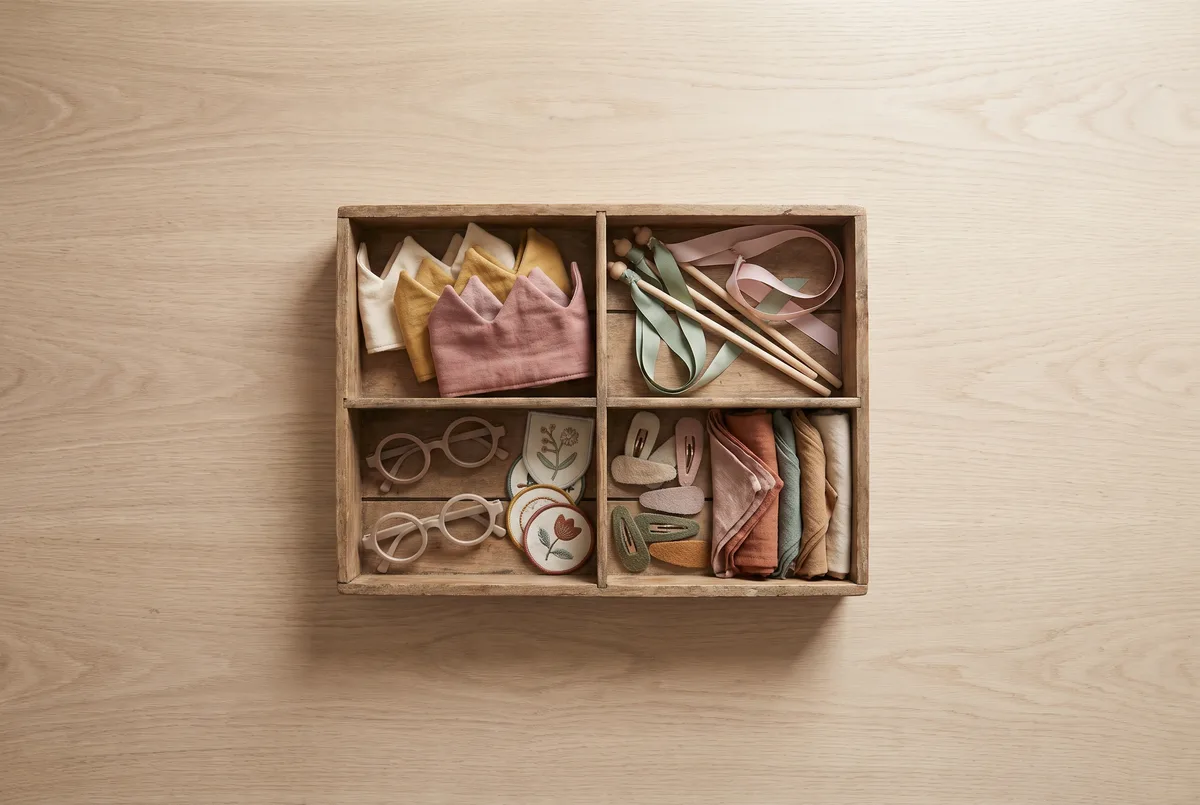 Shallow and compartmented. Nothing here is buried, which is exactly why these pieces stop migrating to the bottom of everything else.
What most families actually end up with
Not one of the three. A combination, and usually the same one: a short rack or a row of pegs for the two or three showpiece layers, one bin or a shallow trunk for everything else, and one accessory tray.
That setup plays to each system's strength. The pieces that need to be seen are seen. The soft mixed things that resist organisation are contained rather than arranged. And the small items that cause the mess have an address.
If you are starting from nothing and want to spend as little as possible, start with the bin and the tray. Add pegs when you notice a cape being worn daily and deserving a permanent visible home. That order costs less and tells you what you actually need, which is the reverse of buying the dress-up centre first and discovering your child prefers to keep everything on the floor.
Buying checks, whichever you choose
Before it enters the house:
Can the child reach the bottom, or the highest hook, without climbing? If not, it is adult storage and it will be operated by an adult.
Is it stable when pulled from one side? Test it loaded, not empty. Racks and shelf frames both fail this way.
Are there pinch points? Hinged lids, folding frames, and sliding drawers are the usual candidates.
Can it be moved by the child? A bin light enough to be carried gets brought to the play rather than the play being brought to it, which increases use.
Does it fit where they actually play? This is the check that overrides all the others. Storage in the correct room beats better storage in the wrong one, every time — a beautifully specified dress-up centre in a spare bedroom is used approximately never.