One zone, not four
The most common costume storage problem is not the container. It is that the costumes live in four places — some in a bedroom wardrobe, some in a playroom bin, the Halloween ones in a loft, and the accessories scattered across all three.
A split collection fails in a specific way. The child cannot see what they own, so they play with whatever is nearest; you cannot see what you own, so you buy things you already have; and tidying has no obvious destination, so pieces migrate further apart with every cleanup.
Consolidating into one zone fixes more than any product will. It does not need to be large or attractive — a metre of wall works. It needs to be one place, in the room where they actually play, and reachable without an adult.
Hang what gets chosen, fold everything else
The sorting principle is frequency, not fabric type.
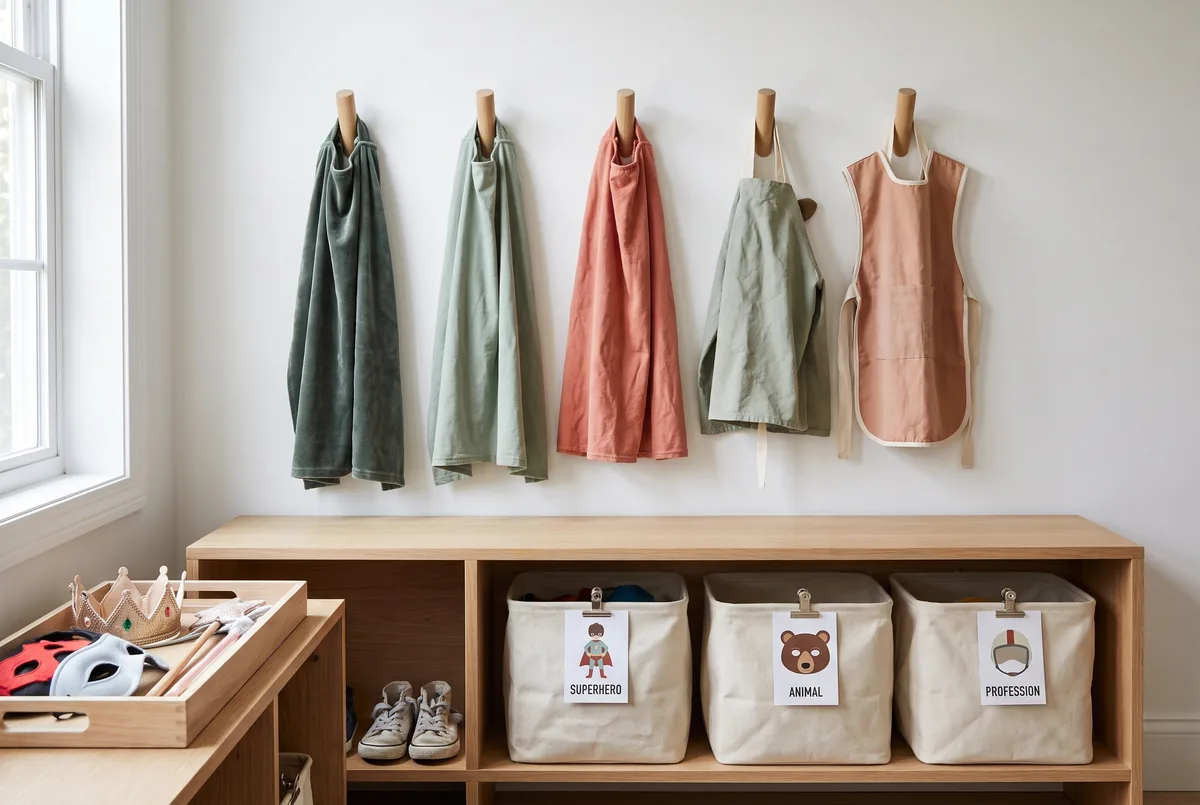
Hang the three to five pieces your child reaches for most — usually capes, dresses, robes, and coats. These earn the visible space because visibility drives use. A cape on a peg gets worn several times as often as the identical cape folded at the bottom of a bin, and nothing about the cape has changed.
Fold everything else into one low bin: fabric lengths, tabards, spare capes, soft props. These are the pieces that survive folding without becoming invisible, because the child is not choosing between them at a glance.
If you are unsure which pieces belong in which pile, do not guess — watch for a week. The pieces that end up on the floor daily are your hanging candidates, because the floor is where the frequently-used things go when the system does not accommodate them.
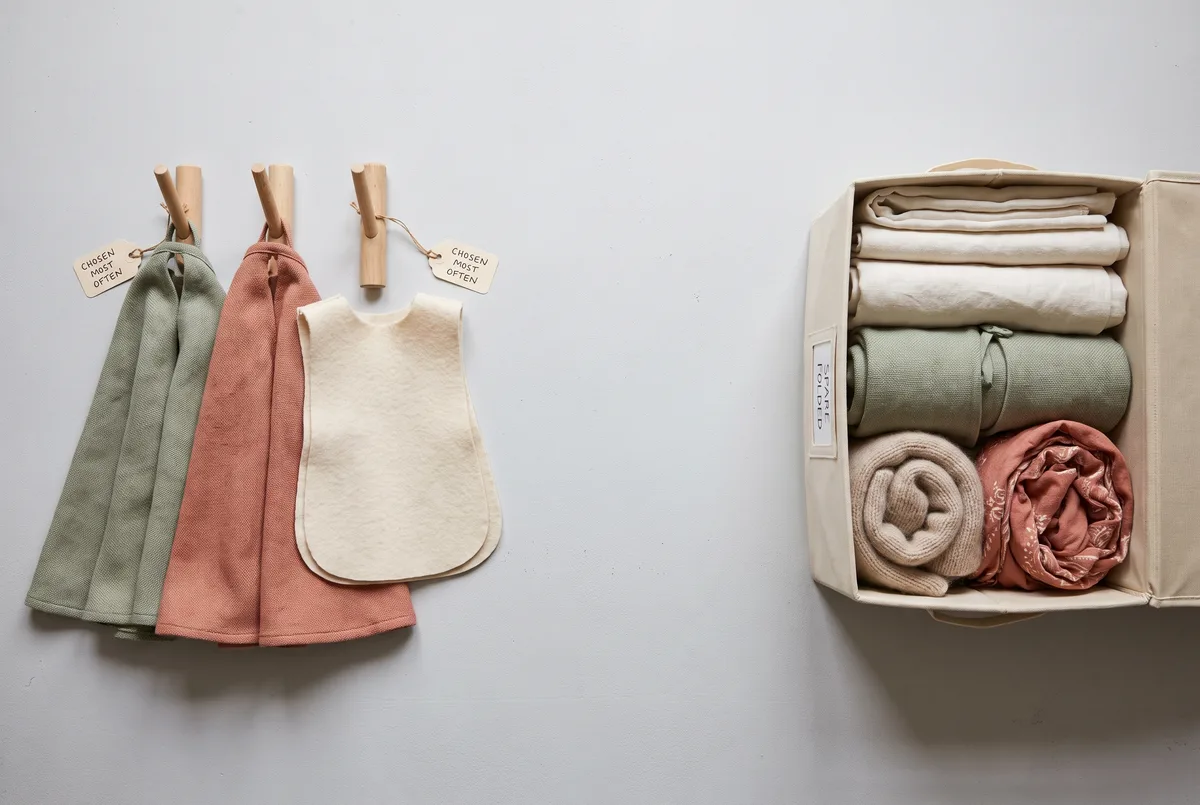 Frequency decides the pile, not fabric type. The three or four pieces reached for daily go on pegs; everything else folds flat into one bin.
For younger children, use pegs rather than hangers. Hanging a garment on a hanger and the hanger on a rail is a two-stage fine-motor task most children do not manage reliably before about four. A peg is a single drop-on action, and it moves independent tidying down to roughly age two.
Accessories need their own shallow home
This is the fix that makes the biggest visible difference to mess, and it is nearly always missing.
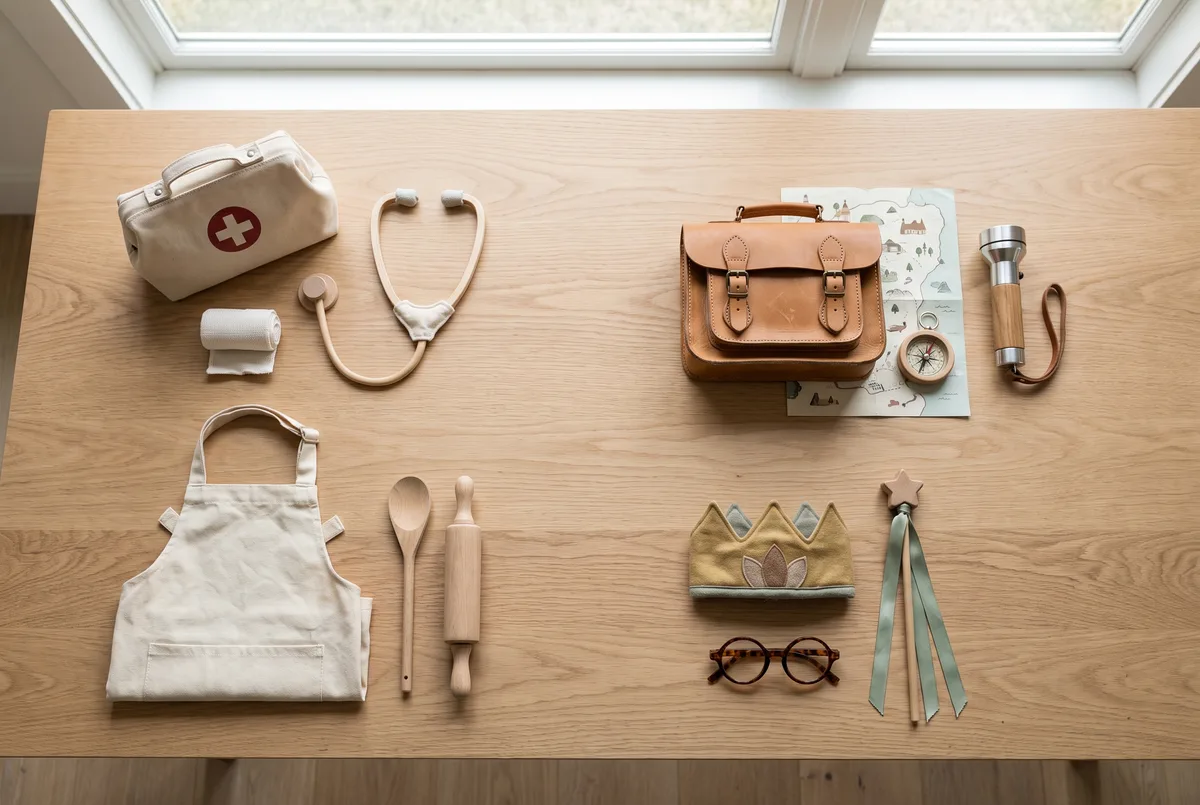
Crowns, wands, badges, glasses, clip-on jewellery, hair clips, and small scarves cause a disproportionate share of the clutter for a straightforward physical reason: they are small enough to fall through everything else, and irregularly shaped enough that they will not stack. Put them in a deep bin and they migrate to the bottom within two days. Hang them and they cannot be hung.
One shallow, open tray at reaching height solves it. Shallow so nothing buries; open so no lid gets left off; at reaching height so it is used without asking.
Compartments help if the collection is large, but do not over-divide. Three or four groupings is plenty — heads, hands, faces, and everything else works fine.
Shoes and hats need separating
Both get crushed, and both crush other things.
Shoes carry whatever they have walked on and should never sit on top of fabric. A low open cubby, a shallow tray, or simply a designated corner of the floor is enough — the requirement is separation, not sophistication.
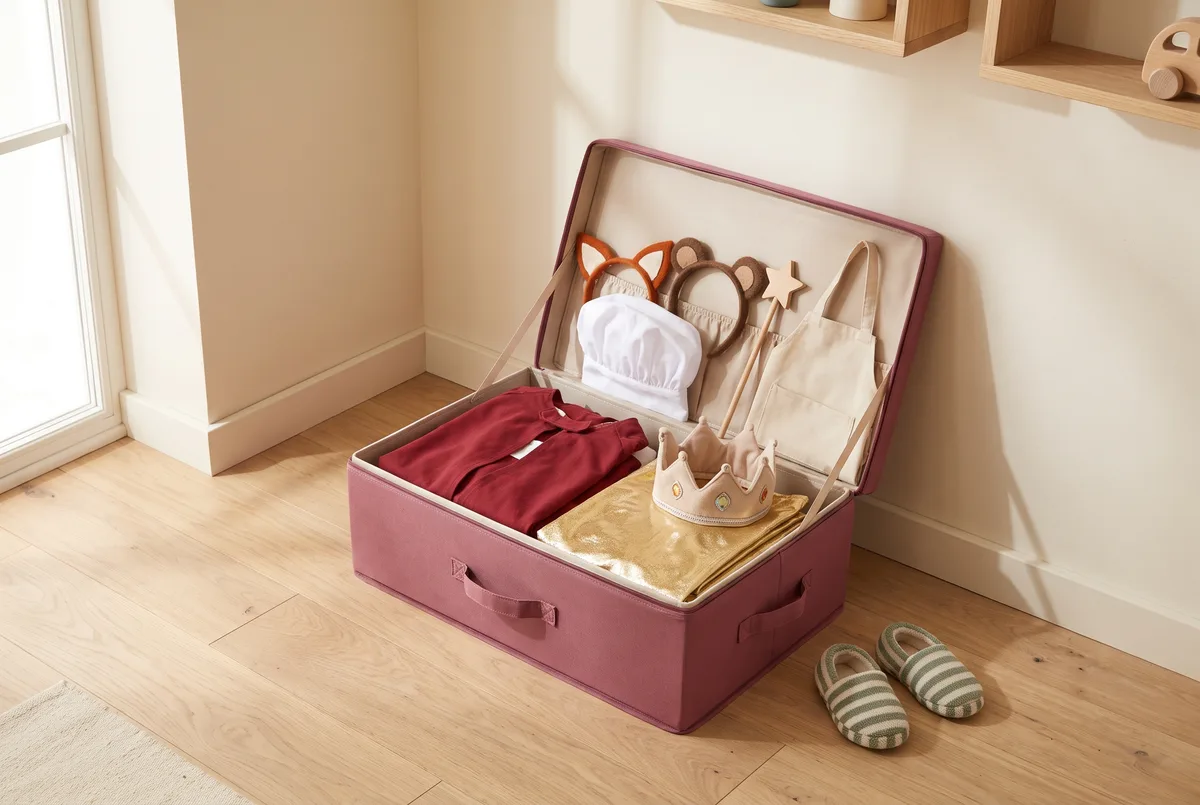
Hats and crowns are the opposite problem: they hold their shape only if nothing is stacked on them. A soft crown at the bottom of a bin comes out flat and stays flat. Give them a shallow shelf or the top of a bin rather than the inside of one.
If space is tight, hats can hang. A row of pegs takes hats, crowns, and headbands well and keeps them visible, which is a genuine bonus since headwear is the fastest way for a child to change character.
Fitting it into a room that is not a playroom
Most families do not have a dedicated playroom, and dress-up has to fit into a bedroom, a corner of a living room, or a hallway. It fits into less space than people expect.
The minimum viable zone is three pegs and one bin — under a metre of wall, and it works. Add a small tray on any nearby flat surface and the setup is complete.
Places worth considering: the narrow wall beside a wardrobe, the back of a bedroom door for pegs, the side of a bookcase, or the space under a window that is too shallow for furniture. Vertical space is usually available even when floor space is not, and dress-up storage is unusually well-suited to it because the items are light.
In a shared room, give each child their own peg or their own bin colour if the sharing is causing friction. In a living room, choose a bin with a lid that can be closed at the end of the day — this is the one case where a lid earns its place, because the alternative is the collection being moved out of the room entirely.
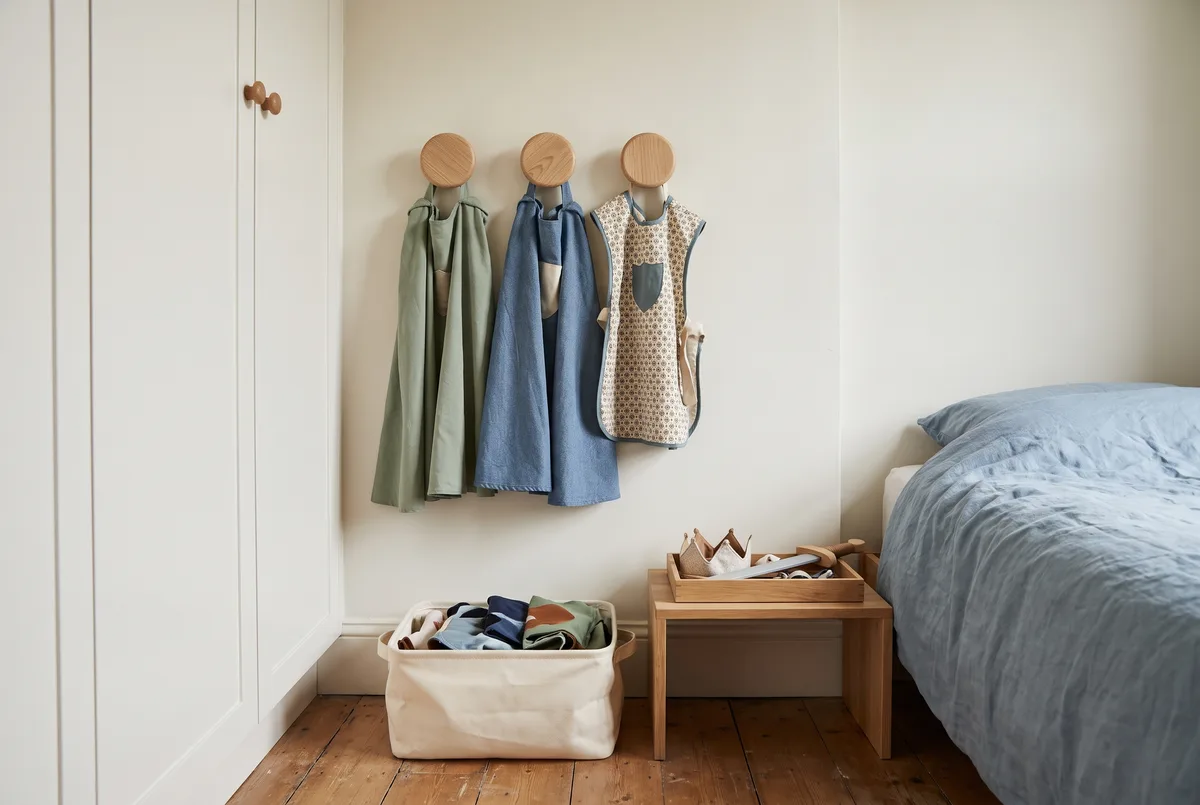 Under a metre of wall in a shared bedroom. Vertical space is usually available when floor space is not, and dress-up pieces are light enough to suit it.
Ten to fifteen pieces, then rotate
Storage stops working above a certain volume regardless of how good the system is, and for most rooms that ceiling is around ten to fifteen items including accessories.
The diagnostic is watching a cleanup. If your child dumps the whole bin to find one thing, or if tidying reliably stalls halfway, the working set is too large — and no additional container will fix it, because the problem is the number of decisions rather than the amount of space.
Move the surplus to a rotation box on a high shelf and swap a few pieces every three or four weeks. This does three useful things at once: it keeps the zone operable, it resets novelty on pieces that had gone stale, and it tells you which items nobody misses. That last signal is the most useful one for deciding what to let go.
Rotation matters most immediately after birthdays and Halloween, which are the two moments the collection jumps in size without anyone deciding it should.
The monthly safety pass
Storage hardware degrades quietly, and a five-minute check once a month catches it.
Wall fixings. Pegs and hooks loosen with use, particularly in plasterboard. Pull each one downward and outward — the direction a child pulls. Rounded hooks only; open upward-facing hooks at head height are worth replacing.
Tipping. Test racks and shelf units loaded, by pulling from one side at child height. If it lifts, it needs a wider base, a lighter load, or a wall anchor.
Lids and hinges. Any lid that can drop under its own weight is a pinch risk. Soft lids, no lids, or a lid support are the options.
Climbing. Look at the zone from a child's point of view: is there a shelf edge, rail, or bin frame that reads as a step? If so, either anchor it or remove the invitation.
The contents. While you are there, run a quick pass for shedding trim, detached gems, and light-up items whose battery doors have loosened — the same checks covered in the kids costume safety checklist.
Doing this monthly rather than annually keeps it a two-minute job. Left for a year, it becomes an afternoon, which is why it does not get done.