Run it as a mission, not a theme
Most themed parties are decoration plus the usual games with new names. Space is one of the few themes with a genuinely better structure available, and it is worth using: run the party as a mission with a crew.
The difference is that a mission has roles, objectives, and an ending. Children who have been assigned a job behave differently from children who have been told what the theme is — they stay in it longer, they organise each other, and the party has a natural shape rather than needing an adult to drive every segment.
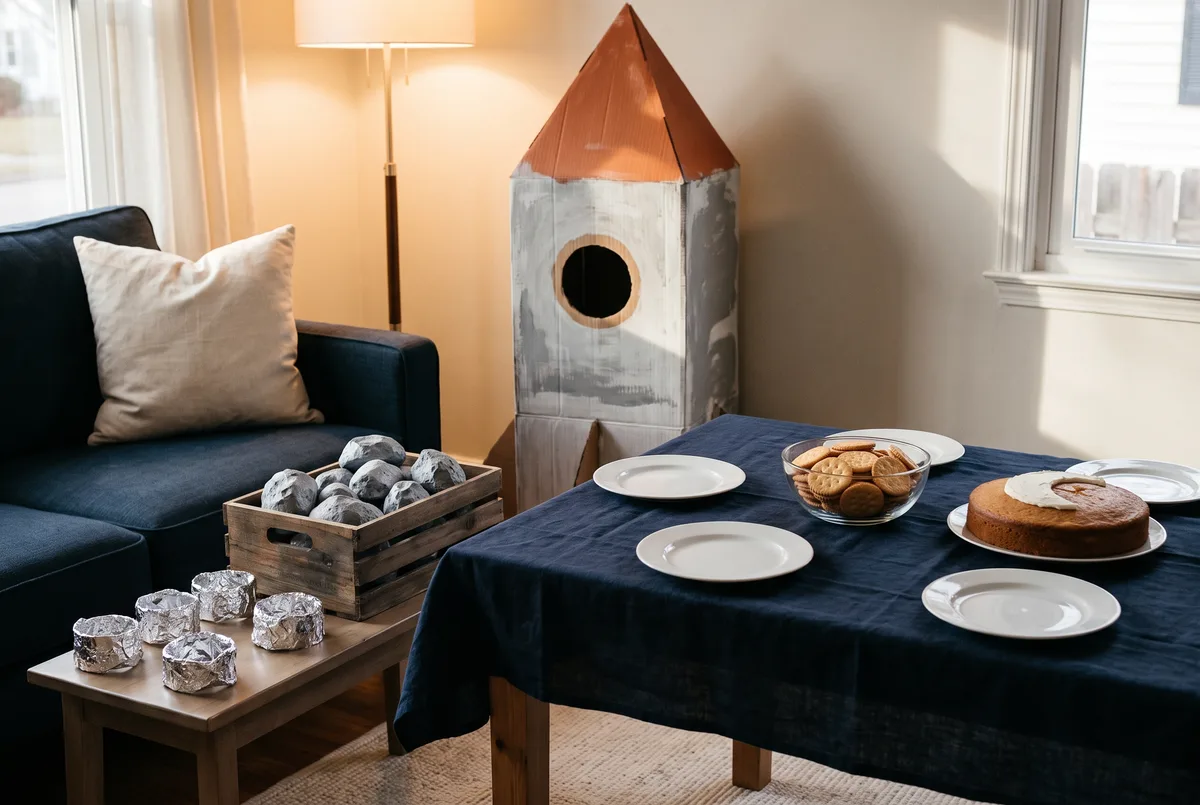
It is also the cheapest theme going. The decorations are cardboard and foil, and the most-played-with item at the party will be a basket of painted pebbles.
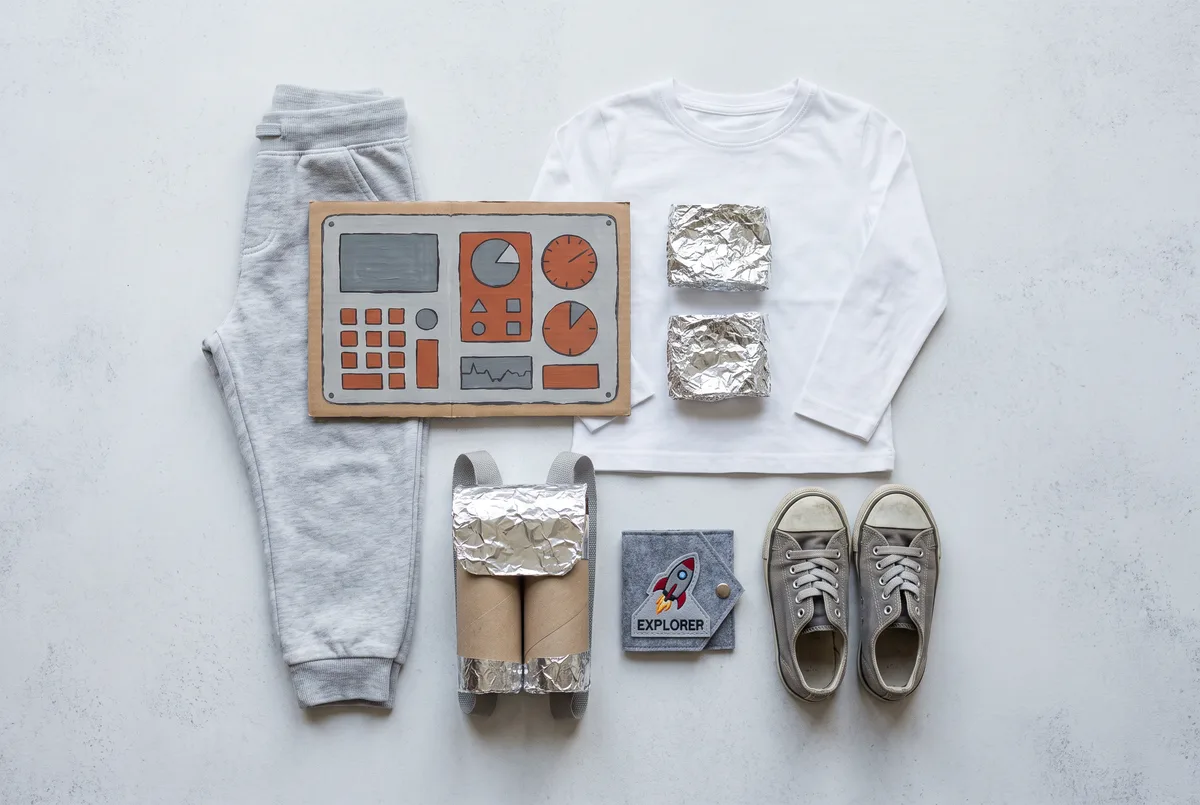
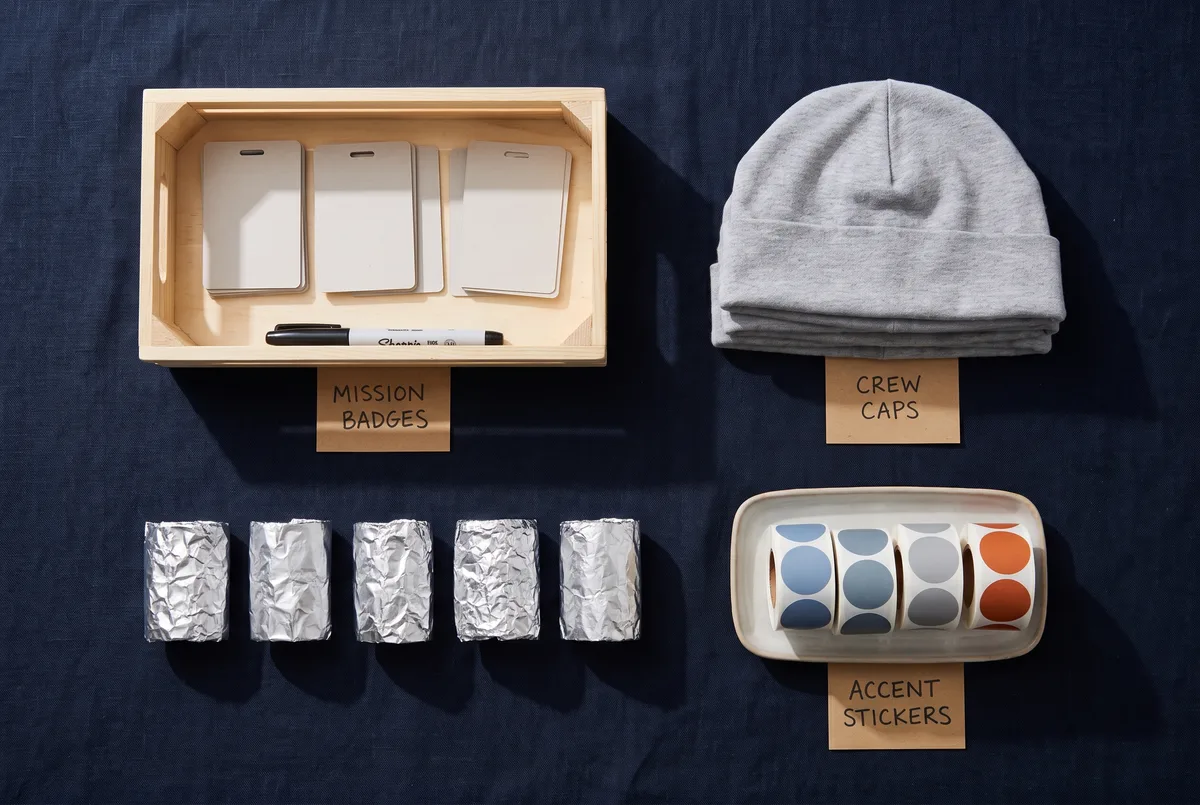 Badges, cuffs, caps. Every guest is in uniform within a minute of arriving, nothing needs sizing, and the badge goes home as the favour.
The crew station replaces costumes
Do not attempt to costume every guest. It is expensive, sizes never work, and children who arrive in their own outfit will not change into yours.
Instead, set out a crew station by the door with two or three lightweight pieces per child:
- A mission badge — card or felt, with space to write a name. The highest-value item on the table, because it is personal and it goes home.
- Foil wrist cuffs — card strips wrapped in kitchen foil. Two minutes each to make, and they finish any outfit instantly.
- A cap or plain headband. Optional, and genuinely optional — some children will not want it.
That is it. Three small things, no sizing, no fitting, and every guest is in uniform within a minute of arriving. It also covers the ragged arrival window, which is the hardest ten minutes of any children's party.
Ask on the invitation for grey, white, navy or black clothes. Most families have all of those, nobody buys anything, and the group photograph looks deliberate.
Skip the helmets
Worth stating plainly because every space costume set is built around one.
Rigid helmets and bubble domes block peripheral vision, muffle hearing, get hot within minutes, and make eating and drinking impossible. At a party — where children are moving fast in a crowded room and there is cake — that combination is worse than at home. They come off within minutes and then have to be stored somewhere.
A badge, cuffs, and a cap carry the theme completely. If a child brings their own helmet, let them wear it and expect it to be off before the food.
Assign roles
This is the step that makes the mission structure work, and it takes two minutes.
Pilot — leads the countdown, drives the ship. Engineer — fixes whatever breaks. Scientist — examines the samples and reports back. Mapper — draws where the crew has been. Communications — relays messages between rooms.
Write the role on the badge as each child arrives and let them choose where possible. Roles do three useful things: they give shy children a defined job, they spread the leading around so one confident child does not run everything, and they let you direct the party by addressing a role rather than a child.
For mixed ages, give younger guests the physical roles — rock collecting, delivering supplies — and older ones the roles with reading or organising in them.
Missions with a stated number
Every game should have an announced ending. This is the difference between a game that finishes cleanly and one that dissolves into an overtired mess.
Moon rock recovery. Hide painted pebbles or foil balls around a room and say how many. The stated total is what makes it end. Fifteen to twenty works for a group of six.
Repair the panel. You announce a fault on the cardboard console; the engineer diagnoses and fixes it while the others hold things and offer opinions. Endlessly repeatable and takes no setup.
Asteroid field. Cushions on the floor, cross without touching the ground. The most reliably popular physical game and it needs nothing.
Planet sorting. Paper circles in different sizes and colours to be sorted and named. Good as a calm option between active games.
Sample analysis. Odd objects in a covered box, identified by touch. Excellent for a quieter stretch before food.
Launch countdown. Ten seconds, a great deal of noise. Best saved for a moment when energy needs a release, and good for including toddlers.
Pick three, not six. A party with three activities and slack between them runs better than one with a packed schedule.
A running order
Two hours, which is the honest ceiling for this age group.
| Time | What happens | Why here |
|---|---|---|
| 0:00 – 0:20 | Arrivals; crew station, badges written, roles assigned | Covers the staggered arrival and gives every guest a job immediately |
| 0:20 – 0:40 | Badge decorating or control panel building | Seated craft while they are still settled and willing to concentrate |
| 0:40 – 1:05 | Two active missions with stated objectives | Peak energy; the announced number is what makes each one end |
| 1:05 – 1:30 | Food, then cake with a countdown | Sitting down resets the room |
| 1:30 – 1:50 | Free play at the station | Needs no adult input and absorbs any overrun |
| 1:50 – 2:00 | Rocks and props returned to labelled crates; goodbyes | Nothing lost, nobody leaving mid-activity |
The craft goes before the running around, not after. Once a group of children has been up and moving, getting them back into chairs to concentrate is genuinely difficult, and the craft ends up abandoned half-done.
Watch for the moment the group stops playing together and starts to fragment — two drifting off, one going to find a parent. That scattering typically arrives about fifteen minutes before the first real upset, and it is the cue to move to food or to the quiet end of the plan rather than to start something new.
Food and decoration, briefly
Decoration: a cardboard rocket, paper stars on the wall, a dark cloth on the table, foil accents. A metre-tall rocket made from a box is the single highest-impact thing you can build, and children will play with it, which no bought backdrop achieves.
Food: plain, and served away from the craft table. Round crackers, fruit, something savoury, water. Elaborate themed food is the lowest-return effort at any party for this age group — four-year-olds eat very little and the decorated biscuit that took an hour is gone in seconds.
The cake is the one place to spend the effort, because it is the moment everyone photographs. A dark icing with a crescent, or a single rocket, is plenty. Do the countdown before cutting it — it costs nothing and the children love it.
Cleanup and afterwards
Label the crates before guests arrive: rocks, cuffs, badges, tools. Children are surprisingly willing to return props to a labelled crate as a final mission, and it saves you an hour.
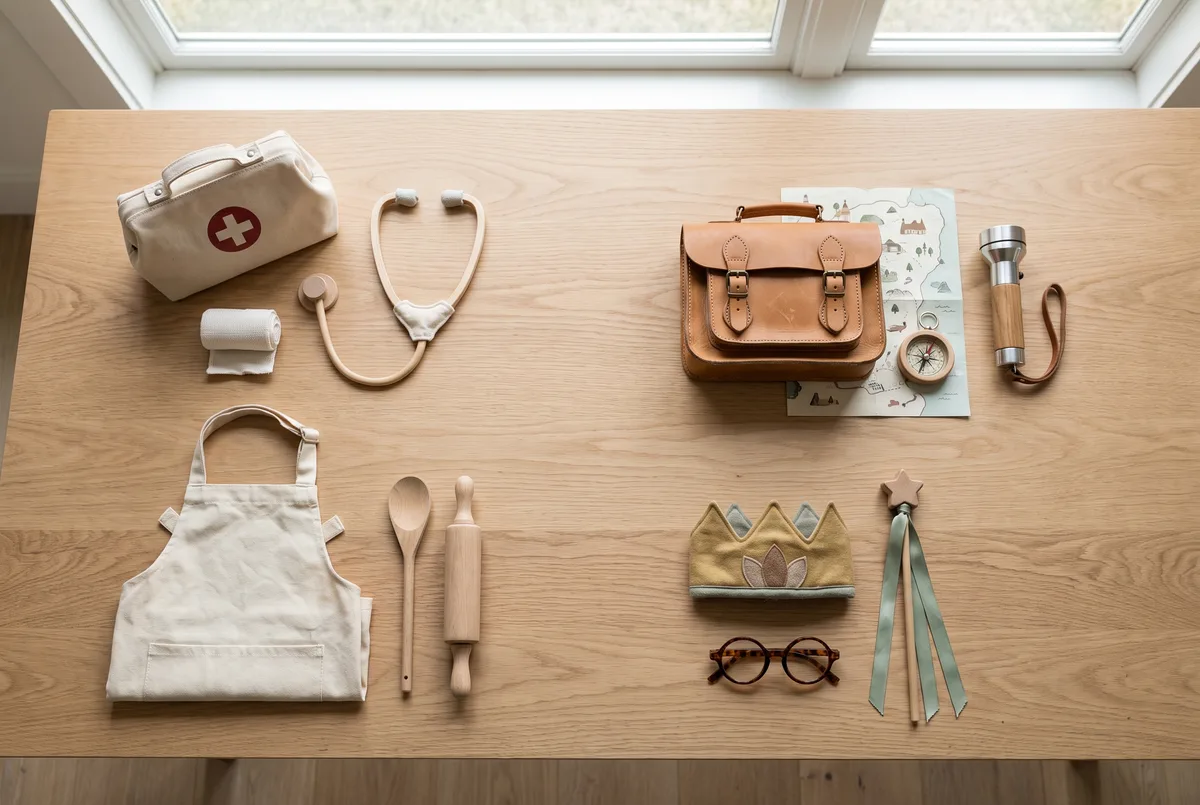
Afterwards, keep the pieces that transfer into ordinary play — the vest, the clipboard, the torch, the moon rocks — and put them into the general dress-up collection rather than a party box. A torch and a clipboard are useful to an explorer, a vet, a detective, and a builder.
The cardboard rocket will survive a few weeks of play before it softens at the folds. That is a fair life for a party decoration made from a box, and rebuilding it is usually welcomed rather than mourned.